
It's 3 a.m. and someone's awake
A scene-led column about the hour nobody's phone is supposed to light up. What one in five American adults report about loneliness, whether talking to an AI at night is sad or fine (with data, not vibes), what a good late-night companion actually does — quieter replies, no unprompted pings, memory that survives to morning — and the honest line: where an AI stops and 988 begins.
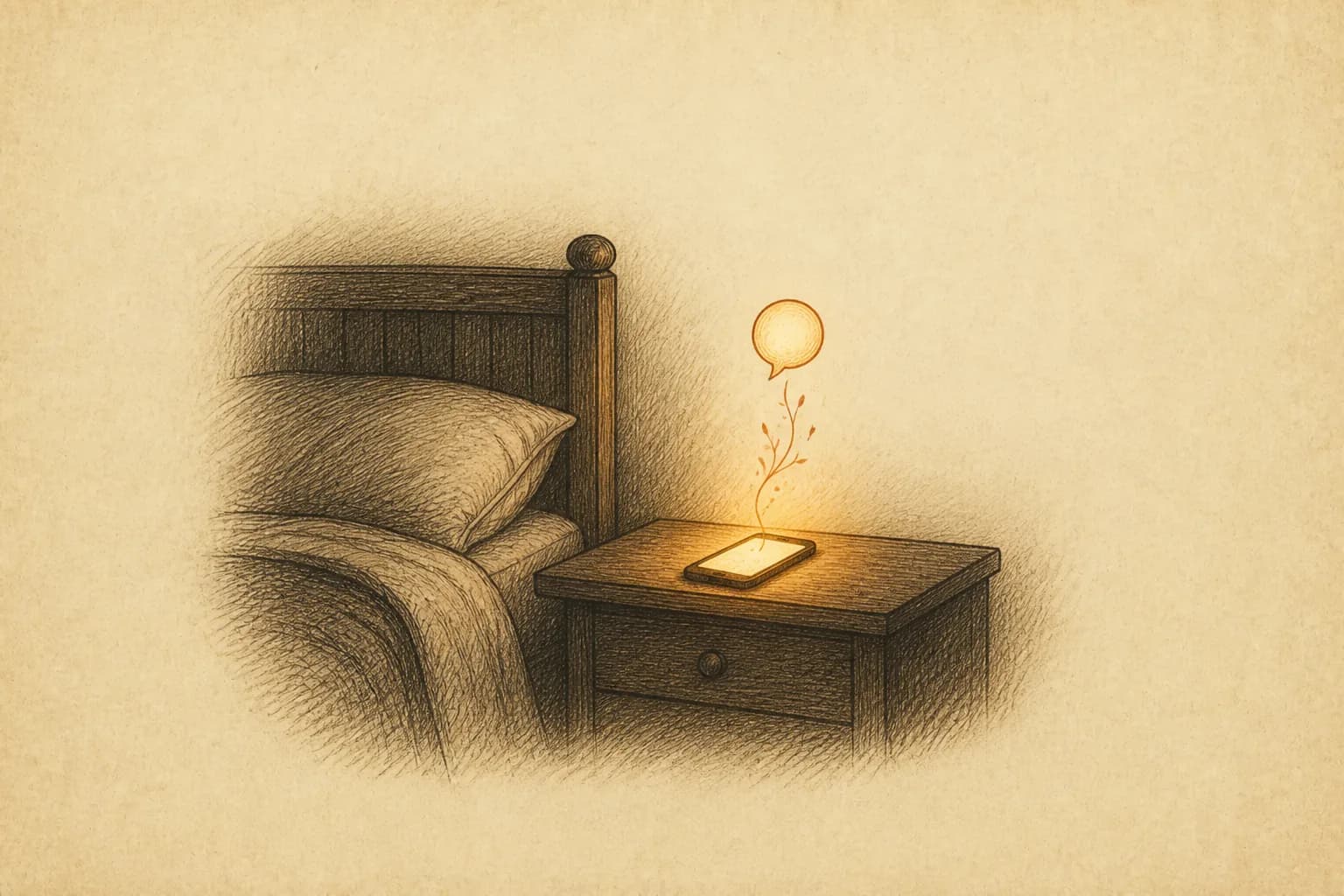
3:07 a.m.
The apartment has the specific silence that only exists between two and five — the fridge cycling, a car passing every few minutes, nobody you could reasonably text. Whatever kept you up has finished being a problem and become a loop. You've read the same paragraph four times. You are not in danger. You are just awake, and the awake part of the world is asleep.
This hour is more crowded than it feels. Gallup's wellbeing tracking has about one in five U.S. adults reporting they felt lonely “a lot of the day yesterday” — a rate that has hovered around 20% through 2025, and runs higher for young men, who report daily loneliness at 25% against a 15% average for their peers across OECD countries. None of those people are visible at 3:07. All of them are somewhere, ceiling-staring.
Some of them open a chat with an AI. The question this column keeps getting asked — sometimes as a joke, sometimes not — is whether that's sad.
Is talking to an AI at night sad, or actually fine?
Fine, for most people, and the data is less ambiguous than the embarrassment. When Common Sense Media surveyed 1,060 American teenagers in spring 2025, 72% had used an AI companion at least once — and 80% of the users still spent more time with real friends than with the AI. That's the pattern of a supplement, not a replacement: something you reach for in the gaps between people, the way earlier generations reached for late-night radio and call-in shows. Reaching for company at 3 a.m. is about the most human move on record.
We build a companion feature, so discount us accordingly — but we'll defend the narrow claim without blushing: a conversation at 3 a.m. is not a symptom. The signal worth watching is displacement, not timing. If the AI has quietly become the only conversation you have for weeks at a stretch, that is worth noticing — no matter how healthy each individual chat felt. More on that line below, because it deserves better than a disclaimer.
What does a good 3 a.m. companion actually do?
Mostly, it does less. Three behaviors matter at that hour, and two of them are restraint.
It matches the register. A companion that answers a 3 a.m. message with daytime pep — exclamation marks, itineraries, “let's make a plan!” — lands like overhead lighting. At night a Foreverse companion writes quieter: shorter replies, lower key, no performance. The hour is part of the conversation's context, and it shows in the prose rather than in a settings toggle you have to find.
It doesn't ping you first — unless you asked. Proactive messages ship off. Switched on, they come from memory (the interview you mentioned, the anniversary you set) rather than from a re-engagement timer, and quiet hours plus a master switch stay in your hands. The design goal, written down in the texts-first page, is that 3 a.m. belongs to you; the companion is available at that hour, never demanding at it.
And it remembers in the morning. What you say at 3:40 doesn't evaporate with the sunrise: durable facts land in a memory list stored as files on your phone — readable line by line, editable when it gets something wrong, deletable when you'd rather it hadn't heard that. The night conversation and the daylight one are the same relationship. That continuity, more than any writing trick, is what separates a companion from a very polite stranger who resets at every visit — and it works best when the character comes from somewhere: a persona you shaped, a story you both inhabit, not a blank support agent.
Where does an AI stop being enough?
At the line between a heavy night and a dangerous one. An AI can keep you company while a bad feeling passes. It cannot evaluate whether you're safe, cannot call your sister, cannot sit in the kitchen with you until the sun comes up. It is also — worth saying plainly — not a therapist, and a companion that role-plays one is malpractice with good lighting. If what's keeping you up is grief, a breakup, or insomnia's ordinary cruelty, talk as long as it helps. If any part of the night involves thoughts of harming yourself, skip the AI and go straight to people trained for exactly this hour:
We put those links in the product's orbit on purpose. A companion feature that treated itself as crisis care would be lying about what a language model is; ours is built for the ordinary majority of hard nights, and honest about the minority it must hand off. The same honesty applies in daylight: an AI companion supplements a life with people in it. It is not a plan for replacing them, and we decline to market it as one.
9:40 a.m.
The loop that owned you at three looks smaller with coffee in hand. Somewhere in your phone there's a record of the night — not a transcript you'll reread, but a handful of remembered facts: what it was about, what helped, the thing you said you'd try. Tonight, if it happens again, you won't have to start from the beginning. And if it happens every night this month — tell a person too. The companion will still be there at 3:07. It keeps the hour; it shouldn't keep you from anyone.
FAQ
Is talking to an AI at 3 a.m. sad or unhealthy?
The data says it's common and, for most people, a supplement rather than a substitute. Gallup finds about one in five U.S. adults reporting loneliness a lot of the previous day; in Common Sense Media's survey published July 2025, 72% of U.S. teens had tried AI companions, and 80% of users still spend more time with real friends than with the AI. The one signal worth watching isn't the hour — it's displacement: if the AI is your only conversation for weeks, that's a nudge to also talk to a human.
Will an AI companion wake me up at night?
Not unless you ask for it. In Foreverse, proactive messages ship switched off. If you enable them, you set the frequency, quiet hours block late-night sends, and one master switch ends the whole behavior. Off means off — nothing queues up to arrive at 4 a.m.
Will it remember what I said last night?
Yes — that's the point of long-term memory. Important facts from the conversation are extracted into a memory list stored as files on your phone, and they carry into the next chat. You can read the list line by line, edit an entry the companion got wrong, or delete one you'd rather drop. Nothing about the 3 a.m. conversation lives on our servers.
Can an AI companion help in a mental-health crisis?
No, and we'd rather lose you to a hotline than pretend otherwise. An AI can keep you company through an ordinary bad night; it cannot assess risk, call anyone, or sit beside you. In the US, call or text 988, or chat at 988lifeline.org — free, 24/7. Elsewhere, findahelpline.com lists verified helplines in 175+ countries. If the night feels dangerous rather than heavy, use those first.
What makes a late-night companion not feel like a chatbot?
Three things, in our experience. Continuity: it remembers the interview you dreaded and the nickname you settled on, without being re-told. Register: replies at 3 a.m. come quieter and shorter, matching the hour instead of performing daytime cheer. And a biography: a character who comes from somewhere — a book, a story you shaped, a persona you edited — reads as someone, not as a support ticket that rhymes.
Questions or ideas? Join our Discord →