
Your character forgot the dragon you slew together. Here's why.
AI roleplay memory loss isn't a bug, it's architecture: context windows, summary compression, and platform-owned history. What lorebooks, character cards, and on-device chat libraries actually fix — and what they can't.
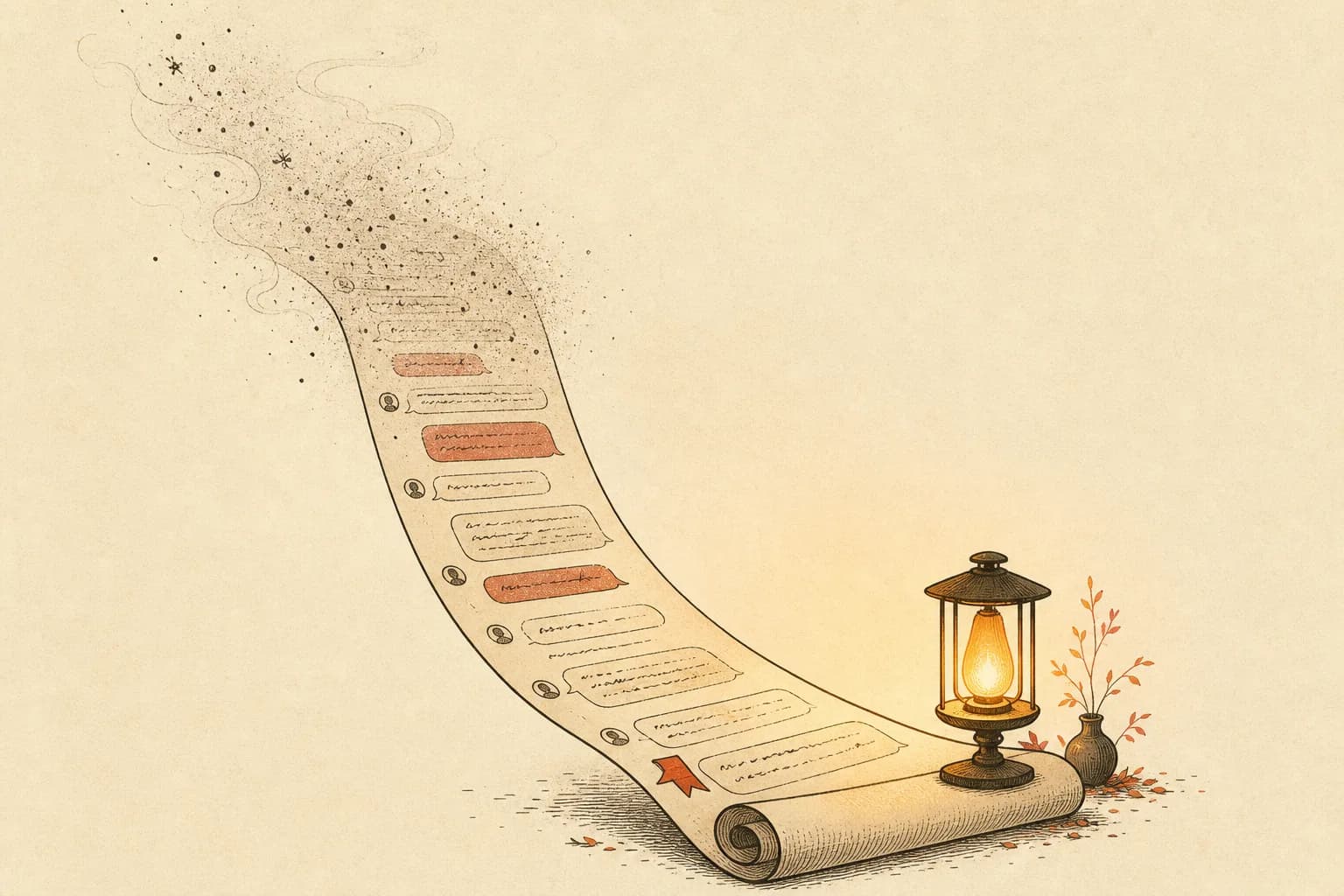
Three hundred messages into a campaign, your companion asks who Mira is. Mira — the sister she swore to avenge in message twelve. Everyone who plays AI roleplay long enough hits this wall, files it under “the AI is dumb,” and moves on. But the forgetting is not stupidity. It is architecture, and once you see the three layers of it, you can actually do something about it.
Layer one: the context window is the only memory a model has
A language model does not remember your chat. Every single reply, the client assembles a package — system prompt, character definition, and as much recent history as fits — and sends the whole thing again. The budget for that package is the context window. When your story outgrows it, something gets cut, and the default victim is your oldest history. The model is not forgetting Mira; it literally never received her this time. You can watch this happen instead of taking our word: the context window visualizer packs a 300-turn chat into an 8k / 32k / 128k window and shows exactly which turns fall off — drop your own tavern .jsonl on it to see where your Mira went.
Layer two: how clients cut corners differs wildly
Consumer chat platforms generally handle overflow invisibly: trim old turns, maybe auto-summarize them into a few lines, never show you what survived. Summaries are lossy in a particular, painful way — they keep plot beats and lose texture: the nickname she only uses when annoyed, the exact wording of a promise. Tavern-style clients (SillyTavern and its descendants) expose the machinery instead: you see token counts, you decide what is pinned, you author the summary yourself if you want one. Less magic, more control — that trade is the whole point of the SillyTavern school of design.
Layer three: structured memory beats raw transcript
The robust fix is to stop treating the transcript as the source of truth and move durable facts into structure. Two tools do the heavy lifting. The character card carries who someone is — personality, voice, backstory — and is re-sent in full every turn, immune to trimming. The lorebook (world info) carries what happened and what exists: keyed entries injected only when their triggers appear in recent chat. Slay the dragon in act one, write a two-line entry keyed to “dragon, Ashfall” — it costs nothing until the topic resurfaces, then lands in the prompt exactly when needed.
This is also why “just give it a bigger window” misses the point. Long contexts cost real money per reply — you are re-buying your entire history every turn — and research on long-context models keeps finding the same “lost in the middle” attention dip. A 40-token lorebook entry that arrives at the right moment outperforms 40,000 tokens of raw scrollback the model skims.
The quieter question: who holds the transcript?
Memory has a second meaning nobody markets: whether your story still exists next year. On hosted platforms your history lives in someone else's database, subject to their filters, their pivots, their shutdowns — ask any AI Dungeon veteran about 2021. The alternative is boring and reliable: chats stored on your own device, in open formats, exportable any time. In Foreverse the entire library — cards, lorebooks, every branch of every chat — lives locally on your phone, and your API keys go straight from device to provider. If we vanished tomorrow, your archive would not.
What to do tonight
Pick your longest-running chat. Move the five facts that must survive into the character card. Turn the ten events that matter into short keyed lorebook entries. Then watch the difference in the next session — not because the model got smarter, but because for the first time it was actually told.
FAQ
Why do AI characters forget things from earlier in the chat?
Every model reads a fixed budget of text per reply — the context window. Once a chat outgrows it, something must be dropped, and naive clients silently drop your oldest messages. The model never 'knew' your whole story; it only ever saw the slice that fit.
Does a bigger context window solve roleplay memory?
It delays the problem and raises the bill, but does not solve it. A 200k-token window still fills after weeks of play, costs scale with every token you resend, and models demonstrably pay less attention to the middle of very long contexts. Structure beats brute force.
What is a lorebook and how does it help memory?
A lorebook is a set of keyed entries — facts about people, places, and events — that get injected into the prompt only when relevant keywords appear in the recent conversation. It acts as cheap, targeted long-term memory: the dragon's death costs zero tokens until someone mentions the dragon.
Can I keep my chat history if a platform shuts down?
Only if your history lives somewhere you control. Platform-hosted services have deleted chats with policy changes or shutdowns before. Clients that store chats on your device in open formats (like SillyTavern's jsonl) make your story archive independent of any company's roadmap.
Questions or ideas? Join our Discord →