
You might be shopping in the wrong aisle
AI fiction tools serve different jobs: preparing a manuscript, reading a long novel, or trying another story branch. Before comparing Sudowrite, NovelCrafter, and Foreverse, test the workflow you actually need: import, continue from a passage, keep the original, and return to reading.
A version of this question appears under every AI-writing-tools ranking, and it never gets a straight answer: “Sudowrite or NovelCrafter? Neither feels right. I'm not writing a book — I just want the one I'm reading to keep going.”
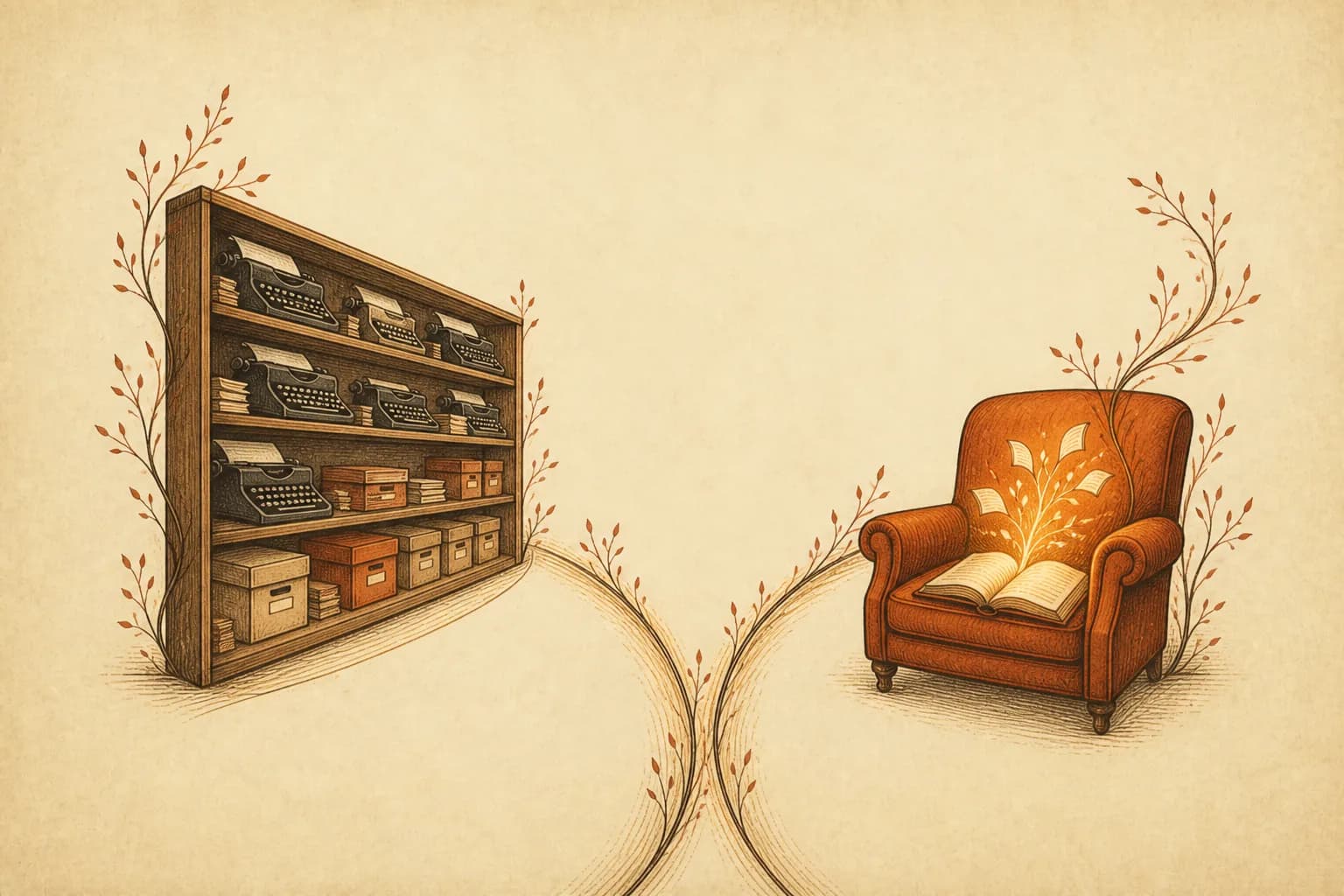
The replies always recommend another author tool. The asker always disappears. Here is the straight answer: they were never choosing between Sudowrite and NovelCrafter, because both live in an aisle built for a different species of person. The rankings that put every “AI fiction tool” on one table are committing a category error — scoring manuscript factories and reading companions on the same dimensions — and the people it fails are readers, who conclude that AI fiction tools are all “too much” when they have simply been handed the wrong catalog.
That is the whole opinion. The rest is evidence.
What does the author's aisle actually sell?
Manuscript infrastructure: keeping a project organized, drafting scenes, revising them, and preparing an export. Sudowrite and NovelCrafter appear in this conversation because people compare them for those tasks. A checklist for a manuscript is useful, but it does not tell you whether a phone feels comfortable when you return to chapter 2,041 of a book you are reading.
Compare concrete needs instead of borrowing a product ranking: do you need a project outline, editorial collaboration, a particular export, or a way to continue a passage without changing its source? Our comparisons with Sudowrite and with NovelCrafter separate these tasks. A feature or price from an old comparison is not a promise about today's plan.
Publishing a novel gives you a different acceptance test, not an automatic buying decision. Try one chapter through your actual drafting, revision, and export process before committing to any tool.
What is a reader-first tool, then?
A reader that writes, rather than a desk that drafts. The center of gravity is a book that already exists — finished, abandoned mid-serial, or ended in a way you cannot forgive — and the tool's first duty is to be a decent home for it: import the txt or epub (we've batch-tested 315 real books on one phone), paginate it, read it aloud on the lock screen. The writing enters at a smaller door: select a passage, say where you want the story to go, and the continuation grows on a branch beside the original. The source text is never edited. Hate the branch, cut it; the book is still clean, and every alternate timeline you liked stays alive — version control for narrative, not a slot machine over it.
The starting point matters more than the label. You can also write original material in Foreverse; here we are testing the narrower reading task. Can you get back to the unchanged book and the same reading position after trying another direction? That is the behavior this comparison is about.
You can run the species test in the first five minutes of any product, before reading a single review. An author-first tool opens by asking about your project: name it, set a word-count goal, meet the story bible. A reader-first tool opens by asking for someone else's file, and the second screen is a reading screen. Onboarding is confession — every tool tells you immediately which chair it expects you to sit in, and the query “AI writing tools all assume I want to publish” is simply what it feels like when every onboarding in the catalog confesses to the same chair.
Check costs against your actual reading habit. With BYOK, model usage is billed by the provider you select; official model access and introductory credits depend on the app version and account. See Foreverse pricing and the BYOK explanation rather than treating a fixed number of continuations as guaranteed. A long context and a short passage can have very different costs.
One question sorts the aisles: whose name would go on the cover of what you're about to make?
If the answer is “mine, eventually, on a shelf” — author's aisle. If the answer is “nobody's, because it's chapter 2,041 of someone else's webnovel and I just need to know how it ends” — you are our species, and no amount of Story Bible will scratch that.
Why do the rankings keep mixing the two?
Because the search queries look identical. “AI continue story,” “AI fiction tool,” “AI novel app” — the words carry no species marker, so lists answer the loudest intent, which is authorship. The scoring dimensions then bake the error in: prose-craft tools, outline depth, words-per-month throughput. Ask those questions of a reading companion and it scores zero across the board; ask a reader's questions — import robustness, pagination comfort, whether a branch can be forked from any paragraph, whether you can switch models per scene — and the author desks score zero right back. Neither zero means anything. The tools are answering different exam papers.
The irony is that the two aisles agree on more than the rankings do. NovelCrafter and Foreverse hold the same position on keys and model freedom; Sudowrite's whole pitch for Muse — a model that won't refuse the dark turns general assistants balk at — matches the reader-side experience that generic chatbots make timid fiction partners. The real split in this market was never quality. It is which chair you are sitting in when the writing happens.
We build Foreverse, so this is a product team's point of view, not an independent ranking. For the reading task, try a passage and a separate continuation branch. Check the original afterward. That small test tells you more about the workflow than a recommendation to buy a competing subscription.
FAQ
I just want to continue a story for myself — should I get Sudowrite or NovelCrafter?
Start with a reading workflow rather than a subscription comparison. Import a text you have permission to use, continue from a passage, and check that the result stays on a separate branch. Foreverse supports this reading-and-continuation workflow on mobile. Manuscript planning is a different task; compare it separately when you need it.
Can I use an author-first tool as a reader?
Sometimes, but text import alone does not establish a reading experience. Test reading progress, pagination, narration, long-file handling, and whether generated changes overwrite the source. Those checks are more useful than assuming every author-oriented tool includes or lacks the same features.
Can a reader-first tool draft an original novel?
Yes. Foreverse can also help with original writing and alternate story directions. That does not automatically establish suitability for your publication process: test outline handling, revisions, collaboration, and the exact export format you need. Reader-first describes the starting workflow, not a ban on writing original work.
Why do AI writing tool rankings never mention reader-first tools?
Partly age — the reader-first category is young and small. Partly query gravity: 'AI writing tools' searches are dominated by author intent, so lists optimize for authors. The practical fix is to sort any ranking yourself before comparing: decide whether each entry is a manuscript desk or a reading companion, and half the head-to-head comparisons dissolve as meaningless.
Questions or ideas? Join our Discord →