
Stop rerolling your story into mush
Why the reroll button quietly ruins AI-assisted fiction: destructive generation, lost alternatives, sunk-cost plotting. Branching — version control for narrative — keeps every draft alive and makes long stories coherent.
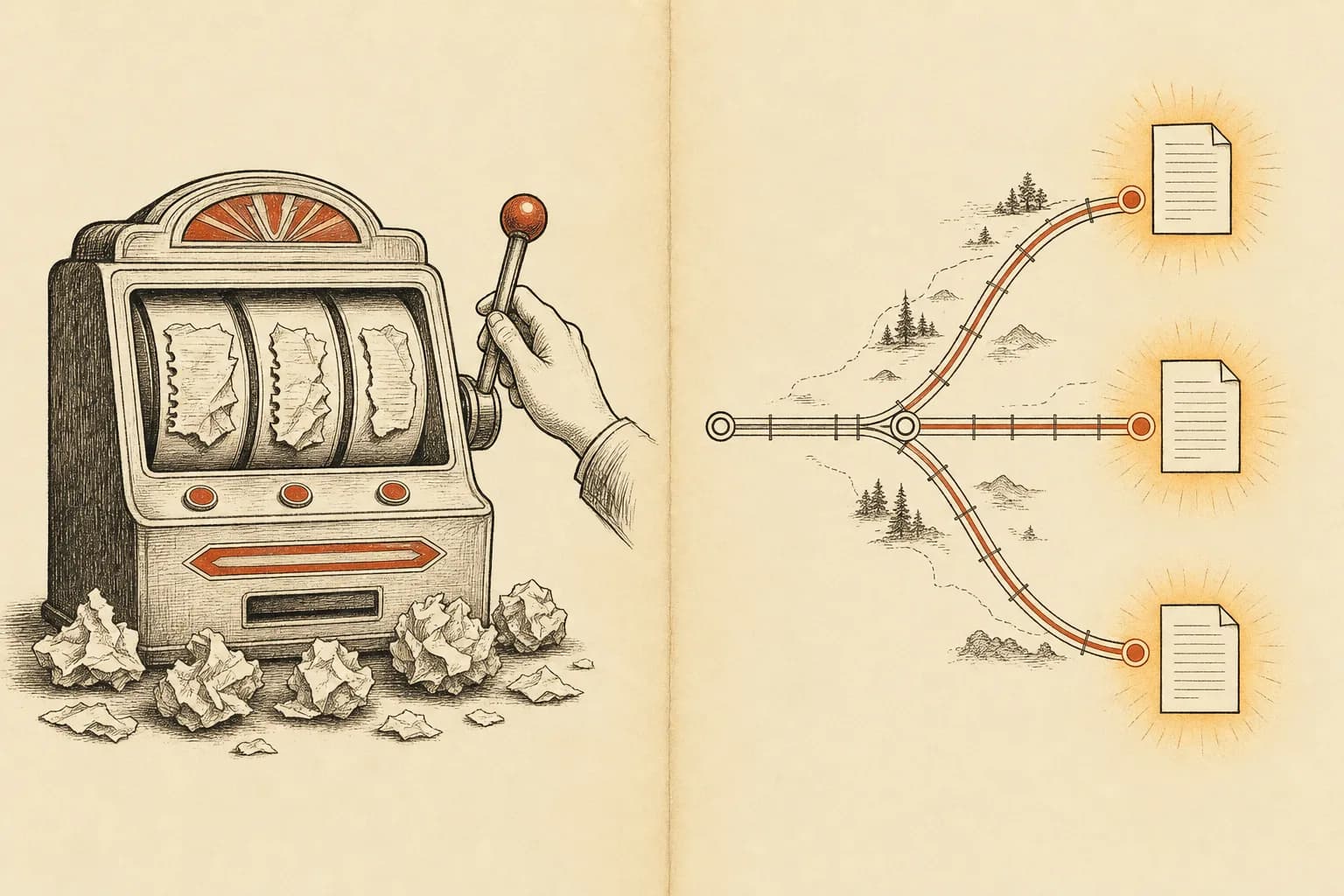
Watch someone use an AI writing tool for an hour and count the rerolls. Generate, frown, regenerate. Frown, regenerate. Somewhere around roll six they accept a paragraph that is worse than roll two — but roll two no longer exists, because the button that promised creative freedom is a slot machine that eats its own payouts.
The reroll button has three design sins
It destroys. Each generation replaces the previous one. The tool frames your options as “this take or a new one,” never “this take and that one, side by side.” Writers are forced to judge drafts from memory — the one cognitive task memory is worst at.
It anchors you to a single line. Forty chapters in, you realize chapter 25 took the wrong turn. In a single-line tool, fixing it means deleting fifteen chapters. So nobody fixes it. Sunk cost takes the wheel, and stories drift into the “it got weird after a while” failure mode every long-form AI user knows.
It teaches gambling, not craft. When the only verb is “try again,” the skill being exercised is patience, not judgment. Comparing two living drafts and articulating why one works — that is editing, the actual craft of writing. The interface decides which behavior you practice.
Software solved this fifty years ago
Programmers stopped overwriting their only copy of anything decades ago: version control made history immutable and experiments cheap. Want to try a risky idea? Branch. Keep both. Compare. Merge what wins. No one would accept a code editor with a single destructive “reroll file” button — yet that is precisely the interface most AI writing tools ship for stories.
Apply the same model to narrative and the workflow inverts. In the Foreverse reader, any paragraph of any chapter can become a fork point. The original line stays intact; the new branch grows its own chapters with its own context. A visible tree shows where every line split and how far each has run. “Regenerate” still exists — it just is not destructive anymore, because a discarded take is simply a short branch you can return to.
Branching changes what the AI is for
On a single line, the model is an oracle you petition for the correct continuation. With branches, it becomes a cheap way to explore the possibility space: generate three genuinely different directions, read them properly, keep what earns its place. The human stays the editor; the machine supplies raw material. That division of labor produces noticeably more coherent long fiction — not because the model improved, but because no single generation carries the burden of being right.
A test for any tool you are evaluating
Ask one question: can I see two versions of the same scene at the same time? If yes, the tool respects drafts, and craft is possible. If no, you are holding a slot machine with a thesaurus — and the house always wins.
FAQ
What is branching in AI fiction?
Instead of regenerating over a passage you dislike, you fork the story at any paragraph and grow an alternative line alongside the original. Every branch keeps its own full text and context. It is version control applied to narrative: nothing is overwritten, everything is comparable.
Why is rerolling worse than branching?
Rerolling is destructive — each new roll replaces the last, so a great take you rolled past is gone forever. It also trains writers into slot-machine behavior: pull the lever, hope, repeat. Branching keeps every candidate alive, so choosing a direction is an editorial decision instead of a gamble.
Does branching work on existing novels, not just AI-written stories?
Yes — that is arguably its best use. Import a finished or abandoned book, fork from any chapter, and explore the ending the author never wrote. The original text stays untouched; each what-if lives on its own line.
Doesn't keeping every branch get messy?
Only if the tool hides structure. With a visible tree — where each line split, how far it has grown, which branch you are on — a dozen live branches stay navigable. The mess in single-line tools comes precisely from not having that map.
Questions or ideas? Join our Discord →