
Three tests that expose fake BYOK in five minutes
BYOK has become a checkbox word. The real definition: your key stays on your device and requests go straight to the provider. Here are the red flags, the three-step verification, and how key storage should work on a phone.
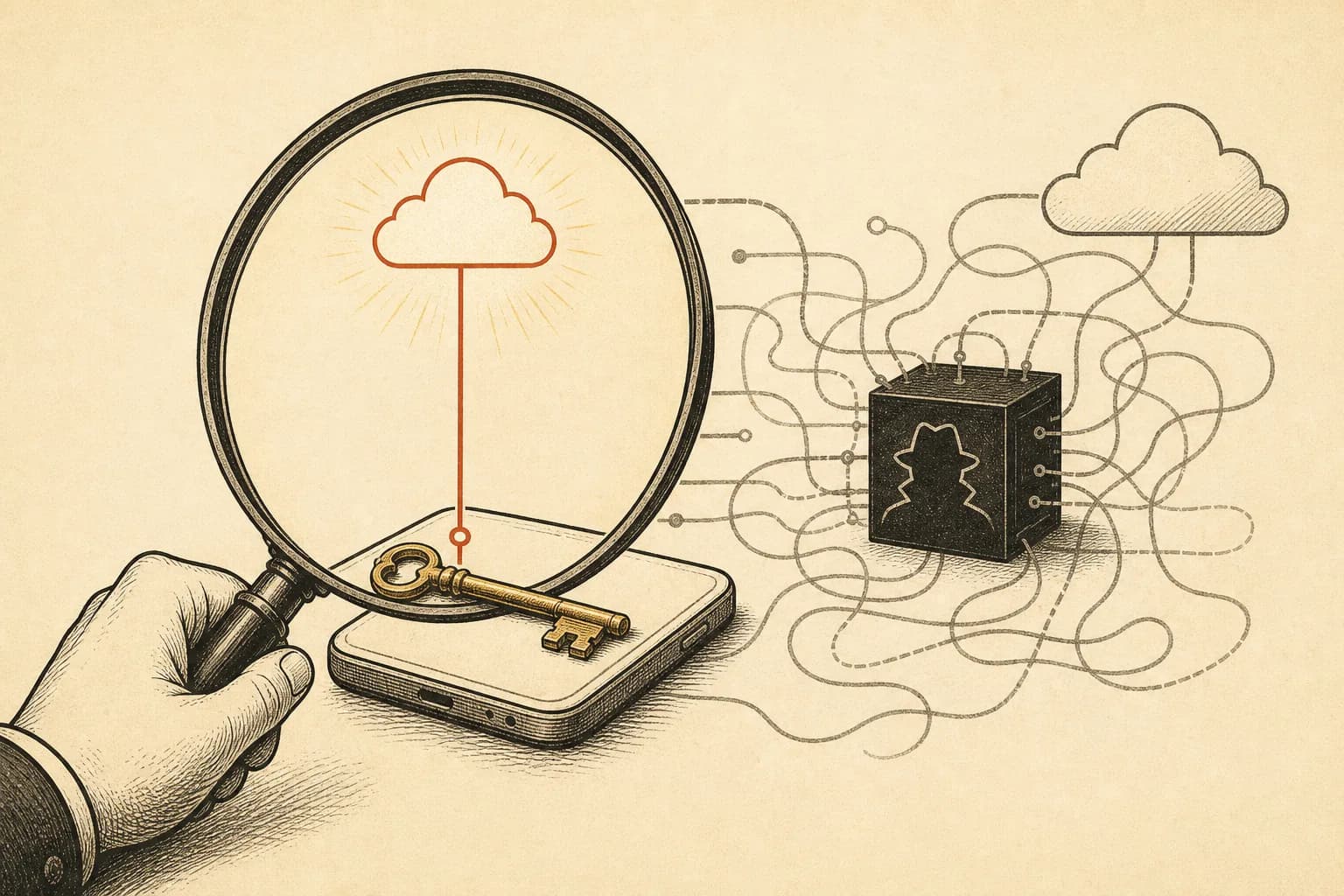
Two stories from 2025, both real. A reseller selling “unlimited” API access vanished overnight, taking a community's prepaid balances with it. Separately, a user pasted a personal OpenAI key into a polished web tool and found $200 of unfamiliar usage on the month's bill. Different scams, same root question: who exactly receives your key?
The definition, without marketing
BYOK — bring your own key — means you hold an API key issued by the provider, the application keeps it on your device, and traffic flows device → provider, full stop. One hop, one trust relationship, covered by the provider's published terms (OpenAI's API data policy, for instance, excludes API traffic from training by default). Every additional server in that path is an additional party who can read, retain, or monetize your conversations — and an additional party who can disappear.
The red flags, ranked by how often we see them
“Add your key to your account.” If the key is uploaded and attached to a cloud profile, the vendor's servers now hold it and almost certainly proxy your traffic. That can be a legitimate architecture — it is just not BYOK, and it deserves a different security review.
No custom base URL field. Genuine BYOK implementations let you point at any OpenAI-compatible endpoint — a regional provider, a local model server on your LAN, a gateway you run yourself. An app that accepts only a bare key with no address is usually routing through its own backend.
Prices that differ from the provider's page. Direct connection means provider list price. A markup means a middleman; a discount means you are the product or the key pool is gray-market.
Verification in five minutes
First, the address test: can you change the API host? Set a custom endpoint and confirm the app respects it. Second, the logout test: sign out of the vendor account (or never create one) — BYOK chats should work regardless, because your keys and history live on the device. Third, if you have the tooling, the traffic test: a quick look at DNS or a proxy session should show requests landing on api.openai.com, api.anthropic.com, or whatever endpoint you configured — not on the vendor's domain.
What good key hygiene looks like on a phone
| Practice | Why it matters |
|---|---|
| Hardware-backed encryption (Keystore/Keychain) | A copied data folder is useless without the device's hardware key |
| Keys excluded from cloud backup and sync | Your key should never exist on a server, including the backup server |
| Spend limits set provider-side | The only airbag that works after a key leaks |
| One key per provider, revocable independently | Losing one credential never strands the others |
| Verify against the provider's own usage page | The app's numbers should match the bill exactly |
This is the checklist we built Foreverse's BYOK layer against: keys encrypted with hardware backing, never synced, never logged, with 60+ providers and any OpenAI-compatible custom endpoint accepted — full base URL included, because guessing version prefixes on the user's behalf is how mystery 404s are born.
Leverage, not just savings
The price argument gets the headlines, but the durable reason to insist on BYOK is leverage. Models leapfrog each other every quarter. With your own keys, switching from one provider's model to another is an endpoint swap — your characters, your library, your history all stay put. Locked into a proxy, you wait for the middleman to renegotiate. Own the key, and the market works for you.
FAQ
What does BYOK mean in AI apps?
Bring Your Own Key: you create an API key with a provider (OpenAI, Anthropic, DeepSeek, etc.), the app stores it on your device, and every request goes from your device directly to that provider. You pay raw provider prices. If the key or your conversations route through the app vendor's servers, it is proxy billing wearing a BYOK costume.
How do I verify an app is genuinely BYOK?
Three tests: (1) it lets you set a custom API base URL, not just paste a key; (2) BYOK chats keep working when you log out of the app's own account system; (3) if you can, watch the traffic — requests should hit the provider's domain, not the vendor's. Any app that 'syncs your key to our cloud' fails the definition.
Where should a mobile app store API keys?
In hardware-backed encrypted storage (Android Keystore / iOS Keychain), excluded from cloud backups, never written to logs or analytics. A copied app-data folder without the device's hardware key should be useless to an attacker.
Is BYOK cheaper than a subscription?
For heavy users, usually — you pay provider list price with no middleman margin. For light users a flat subscription can win. The durable benefit is not price but leverage: when one provider raises prices or degrades a model, you switch endpoints in a minute instead of migrating your life.
Questions or ideas? Join our Discord →