
Our LLM judges called human writing “AI-flavored” — 88% of the time
We ran a double-blind panel: four heterogeneous LLM judges, gold anchors labeled by real humans, both presentation orders. Gold accuracy came back at 12% — the judges systematically inverted, calling million-conversation human hits “AI” and the copy a real user flagged as AI “human.” Inter-judge agreement was 86%, and they agreed on the wrong answer. Full failure data and the rule we adopted.
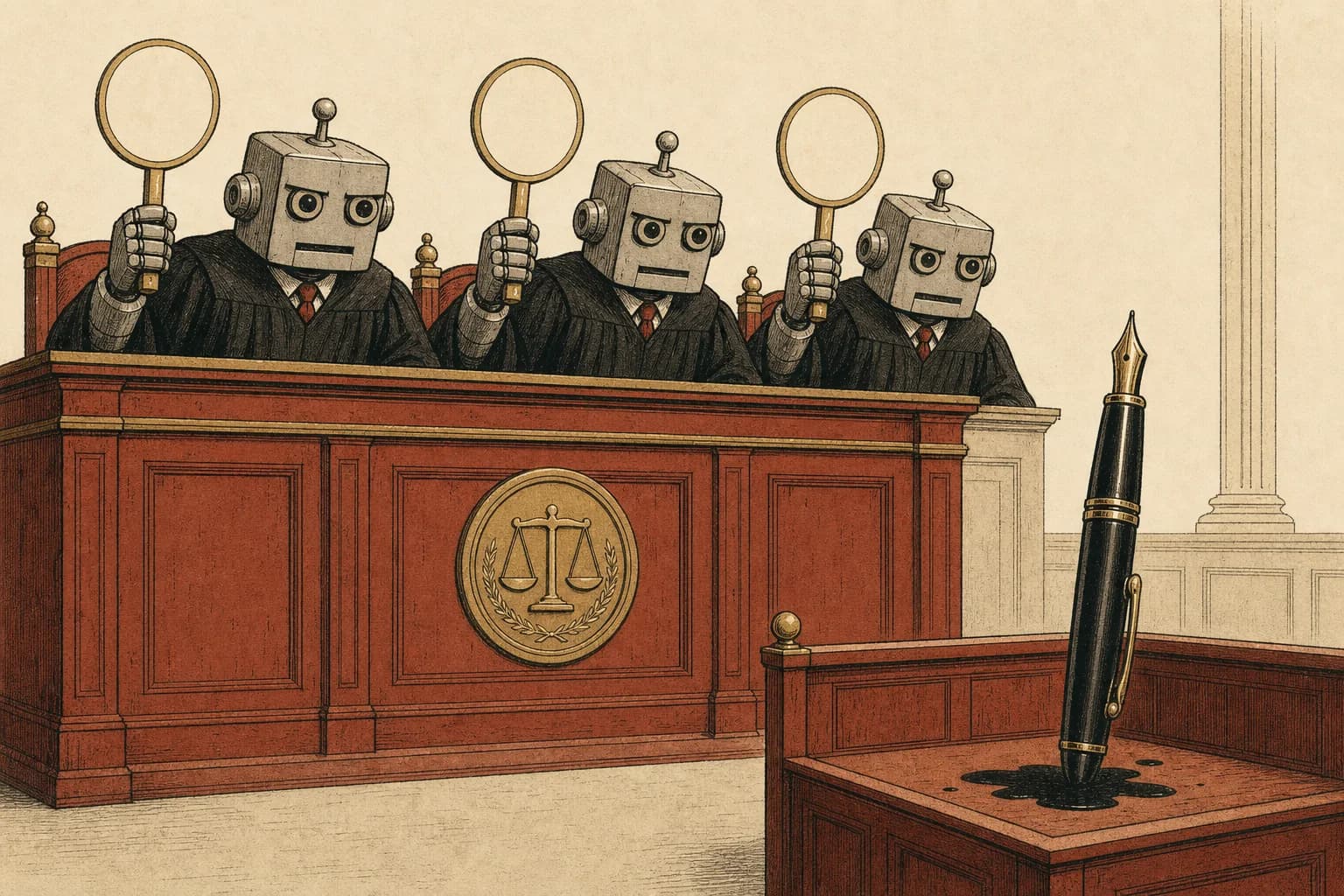
The setup was textbook. Four LLM judges on different base models. Double-blind pairs. Both presentation orders, to cancel position bias. Gold anchors seeded into the pool — samples where humans had already reached a verdict, including character-card copy a real user had flagged as “obviously AI” on sight, and community cards written by humans that had accumulated over a million conversations.
All the judges had to do was answer, for the anchors, “which of these two reads more human?” They scored 12%.
Failure one: not noisy — inverted
Twelve percent is the interesting kind of failure. A coin flip scores 50%; a noisy judge hovers around it. Scoring 12% means the panel was confidently wrong in a consistent direction: the copy humans called AI, judges praised as “grounded, textured, clearly human”; the human-written hits, judges dismissed as “formulaic, likely generated.”
Failure two: agreement without accuracy
Pairwise agreement across the four judges was 86%. Before the experiment we'd planned to use majority voting for robustness. That plan died here: voting cancels independent random errors, but these errors weren't independent — the judges shared the same learned bias and converged on the same wrong answers. High consensus made the panel look more trustworthy while being reliably backwards. Separately, in about a third of the pairs, simply swapping presentation order flipped the verdict — position bias is a documented LLM-as-judge failure mode (the MT-Bench paper measured it systematically); we just met it again in our own data.
Failure three: prompting rescues one model family, not the rest
After the first round collapsed, we ran a dedicated calibration round — corpus expanded to 17 pairs, more heterogeneous judges — with an explicit debiasing preamble spelling out, among other things, that detail density is not evidence of humanity. A Claude-family judge jumped to 83% (the original four-judge setup had scored 12%): its bias lived at the prompt layer. DeepSeek, GLM and Qwen didn't move past 25–33% with the identical preamble; their prior sits deeper than instructions reach — they even cited the community stat-bar formatting our imitation cards copied as “evidence of real community interaction.” Even the rescued judge only barely clears the calibration bar we now enforce, so “barely usable, single configuration” is the honest summary.
The rule we adopted
One sentence went into our engineering standards after this: an LLM judge that has not passed gold calibration (≥80% on human-consensus anchors) must not be used as an optimization target. Not for scoring, not for regression gates, not for leaderboards. Our current stack is three layers: a rule-based detector (phrase blacklists plus sentence-pattern quotas, calibrated against real user judgments — we once had to fix a rule that false-flagged human scenery writing, after which human samples scored clean) as the daily gate; human spot checks as ground truth; LLM blind review only for relative before/after comparisons of the same text. The rule’s most recent shift on duty was the judge-calibration round of our Foreverse vs SillyTavern benchmark — six judge models sat the exam, three got licenses.
And the honest boundary: we hold samples of carefully templated AI copy that dodge every pattern rule and sail past both the detector and the judges. The deepest layer of AI flavor lives in whole-text texture — uniform detail density, zero idle sentences, immaculate structure — and nothing automated currently catches it. What catches it is still a well-read human, reading aloud, frowning at the right moment.
FAQ
What is gold calibration for LLM judges?
Before trusting a judge, you test it on anchor samples where humans already agree on the answer. Our four judges scored 12% on those anchors — far below the 50% a coin flip would get, which means the panel wasn't noisy, it was systematically inverted.
Doesn't 86% inter-judge agreement mean the panel is reliable?
No, and that's the expensive lesson. Agreement measures consistency, not correctness: four judges can share the same training-induced bias and confidently converge on the wrong answer. Majority voting cancels random noise; it cannot cancel a shared systematic bias.
Did anti-bias prompting fix it?
It depends on the model. In a follow-up calibration round on an expanded corpus, an explicit debiasing preamble lifted a Claude-family judge to 83% gold accuracy (the original four-judge setup scored 12%). DeepSeek, GLM and Qwen stayed at 25–33% with the identical preamble — their bias sits below the prompt layer. And 83% only barely clears the ≥80% bar we set afterwards.
So how do you detect AI flavor now?
A three-layer setup: a rule-based detector (phrase lists plus sentence-pattern quotas, calibrated against real user judgments) as the regression gate; human spot checks as ground truth; and LLM blind review only for relative before/after comparisons of the same text, never as an absolute verdict. Honest limit: templated AI copy with perfect structure passes both rules and judges — no automated silver bullet exists.
Questions or ideas? Join our Discord →