
Story structure doesn't wash off
Word-list AI detection is a lost arms race — flagship models already pass slop scans clean. The StoryScope paper (arXiv:2604.03136, UMD + Google DeepMind) found something sturdier: narrative structure alone separates human from AI fiction at 93.2%, and professional-grade rewriting moves that by 1.6 points. We projected its lexically visible features into a browser tool and validated on 78 passages of our own corpus: five axes separate (direct emotion naming leads at d=1.46), every direction matches the paper — and our own show-don't-tell discipline turned out to carve a brand-new fingerprint. Also: how we killed our strongest number because it was fake.
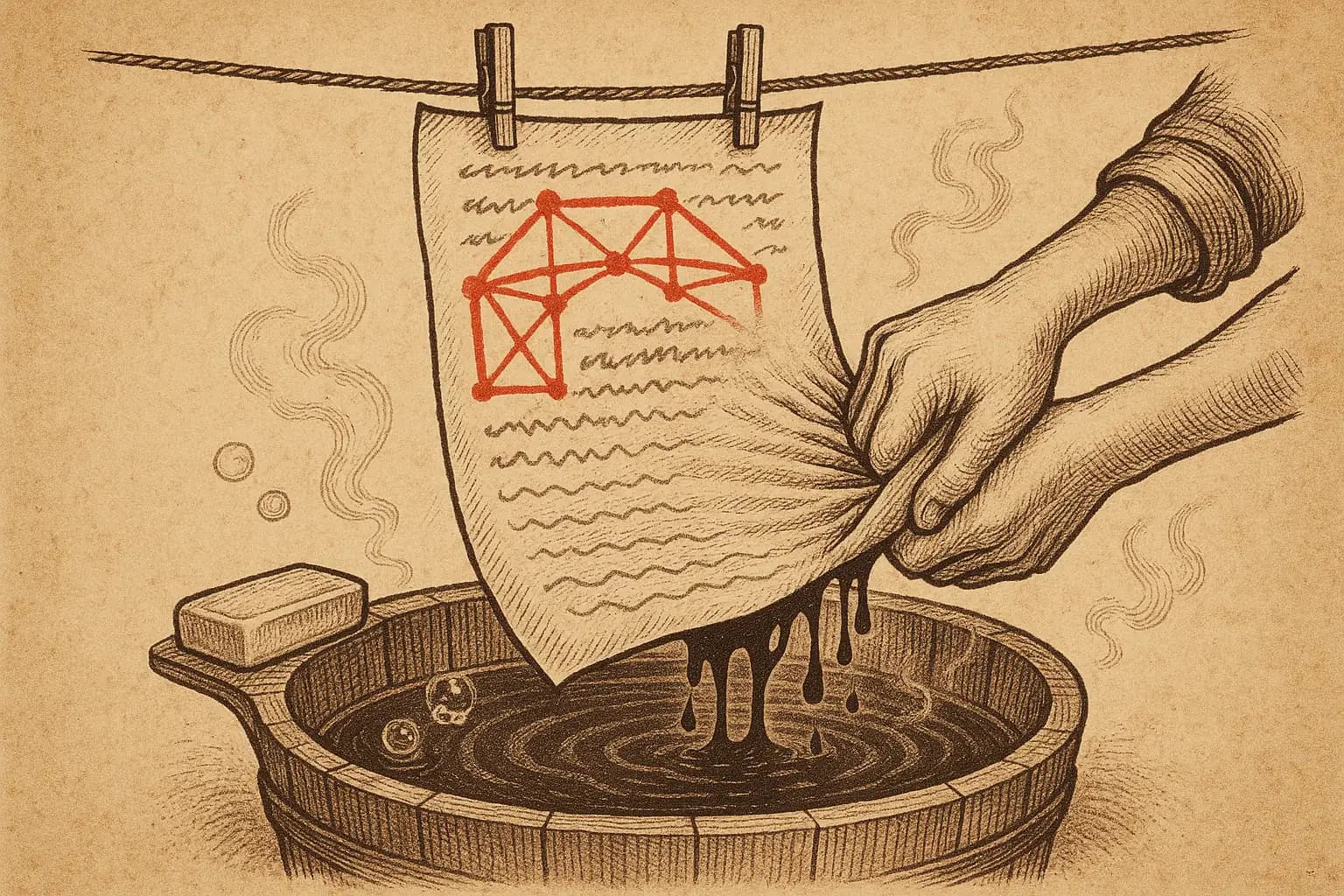
We maintain a 95-phrase slop lexicon, so this is us reporting the score against our own team: the word-list arms race is over. In our July calibration, single-shot greetings from current flagship models averaged 0.22 lexicon hits and the two strongest models scored zero across the board — clean scans on their best behavior. Meanwhile an entire "humanizer" industry exists to launder whatever vocabulary the lists still catch. Police the words and you get text with different words. The question that matters in 2026 is what survives the wash.
The paper: rewrite the sentences, keep the fingerprint
StoryScope (arXiv:2604.03136, Russell, Rajendhran, Pham, Iyyer and Wieting — University of Maryland with Google DeepMind; code on GitHub) asked that question at scale: 61,608 stories, 304 narrative features annotated per story. Not vocabulary features — story features. Whether the theme gets stated outright or left for the reader. Whether emotion is named ("she felt afraid") or performed through action and body. Whether the timeline ever looks backwards. How ambiguous the protagonist's choices are allowed to stay.
Two results carry the paper. Narrative features alone separate human from AI fiction at 93.2% macro-F1 — no perplexity, no word statistics, story shape only. And when they attacked their own classifier with style-level rewriting, detection moved from 95.5% to 93.9%. A paraphrase pass rewrites every sentence and leaves the plot skeleton, the emotional register, the timeline discipline all standing. Structure doesn't wash off. When the paper hit r/WritingWithAI it read as bad news for anyone shipping AI-assisted fiction through an editing pass: the tell isn't in the prose your editor can fix, it's in the story.
What we could honestly borrow
We wanted this as a tool, and the honest version requires saying what can't be borrowed. The paper's pipeline is LLM annotation — roughly $1,600 of labeling — and several of its strongest features (subplot integration, moral ambiguity of the ending) need a model that actually read the story. No browser runs that. What a browser can run is the subset of constructs that leave lexical shadows: named emotions have a vocabulary, retrospection has markers ("years ago," "she remembered"), narrated cognition has verbs ("he knew," "she realized"), scent imagery has a word field. So we wrote those as fast text rules, ran them over 78 passages with known answers — 24 human (twelve public-domain novels, 1898–1926, two windows each), 24 from our own AI production books in English, plus 30 Chinese — and kept only the axes that actually separated. A 4,000-word chapter scans in under 30 milliseconds, in the browser, nothing uploaded.
| Axis | What it counts | Human | AI | Cohen's d | AUC |
|---|---|---|---|---|---|
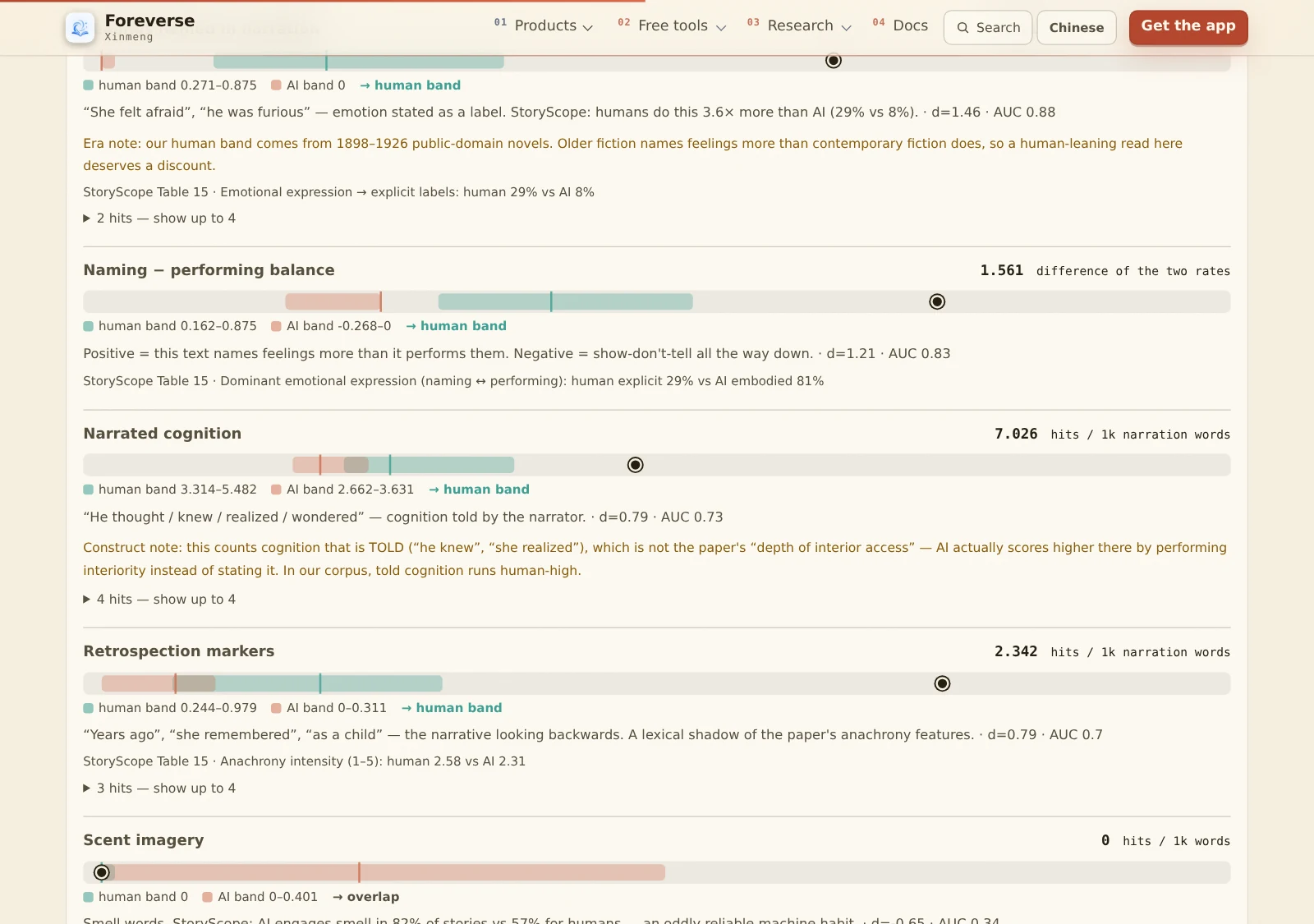
| Direct emotion naming | “she felt afraid” per 1k narration words | 0.63 | 0.06 | 1.46 | 0.88 |
| Naming − performing balance | named emotion minus embodied emotion | +0.49 | −0.12 | 1.21 | 0.83 |
| Narrated cognition | “he knew / realized / wondered” per 1k | 4.72 | 3.11 | 0.79 | 0.73 |
| Retrospection markers | “years ago”, “she remembered” per 1k | 0.71 | 0.29 | 0.79 | 0.70 |
| Scent imagery | smell words per 1k (AI runs higher) | 0.09 | 0.24 | −0.65 | 0.34 |
The row worth staring at is the first: humans name emotions about eleven times as often as our AI corpus, d=1.46, the strongest separation we kept. And all five rows point the same direction as the paper's Table 15 — humans label feelings more, look backward more, narrate cognition more; AI reaches for smell oddly often (the paper has it in 82% of AI stories versus 57% of human ones). That directional agreement is the whole validation: we didn't keep rules that happened to split our corpus, we kept rules whose split matches constructs measured on 61,608 stories.
Two results we didn't expect
The first is the best thing in the whole exercise. Our English AI corpus isn't raw model output — it's production books written under a strict anti-slop discipline, the house rules that ban stock phrases and enforce show-don't-tell. Those books pass word-list scans. And on the emotion-naming axis they are not just low, they are flat zero in 19 of 24 passages. Human novelists, it turns out, cheerfully write "she was afraid" a few times per chapter; a model under a show-don't-tell regime never does. The discipline that scrubbed the vocabulary tells carved a cleaner structural tell underneath. That's StoryScope's thesis arriving from the opposite direction: polish operates on words, and the polish itself became measurable one layer down.
The second is a confession with a lesson in it. Our single strongest number never shipped: protagonist-name concentration separated at d=1.71, better than anything in the table above. It was fake. The direction contradicted the paper's construct, and the cause was the corpus, not the writing — novels from the 1900s follow a "one named hero, nameless extras" convention, while our production books carry a naming discipline that names everyone. Two house styles colliding, masquerading as a human/AI signal. We cut it. Anyone building a DIY detector should assume their biggest number is a corpus artifact until a construct from someone else's data agrees with it — separation is cheap, validity isn't.
Why we still won't call it a detector
Three of our 24 human calibration passages land on the AI side of the leading axis: Hemingway's The Sun Also Rises, a Zane Grey western, Henry James's The Turn of the Screw. Iceberg prose names no feelings; that's the style. Any tool in this territory that returns "93% AI" as a verdict is choosing to be wrong with confidence, so ours refuses the genre convention: it counts bands instead. Paste a chapter and the summary reads like "4 axes human-side · 1 overlap · 0 AI-side" — and when a value sits where the reference bands overlap, it says overlap. We tested the alternative tie-break rule that forces more calls: wrong-direction readings went from 5 of 78 up to 11. The tool prefers saying "don't know" to saying something false — the swap traded extra ties for six fewer wrong answers.
The other honesty is the reference corpus itself. The human band is built from 1898–1926 public-domain fiction, and older fiction names emotions more than contemporary fiction does — so a human-leaning read deserves a discount, and the axis note under the chart says exactly that. The AI band is built from disciplined production books, the hard case, because that's what we had full rights to; raw single-shot model output would likely separate even harder. Sample sizes are printed on the card. None of this makes the tool weaker; it makes the numbers mean what they say.
And it's deliberately the fourth lens, not the only one. Word-list scanning (the flavor check), texture statistics (prose stats), model-side perplexity (text x-ray) and now narrative structure each fail differently — a word list misses a careful model, perplexity misses a paraphrased text, structure misses a human minimalist. Four fallible instruments that disagree in informative ways beat one oracle that lies with confidence.
Try it on something you know
The tool is at /labs/narrative-fingerprint. Paste a chapter — 600 words minimum, everything runs locally — or hit the two built-in samples for the fastest demonstration: the Gatsby excerpt reads 4 axes human-side, 1 overlap; our own AI production chapter reads the perfect mirror, 0 human, 1 overlap, 4 AI-side. Every axis unfolds into the sentences it counted, so you can audit the evidence, and a paper panel quotes Table 15 with a checkmark on each construct we could project and a cross on each one we couldn't.
Paste The Sun Also Rises and it will lean AI. We shipped that reading on purpose: tune the axes until Hemingway passes, and the same tuning waves through every AI chapter that learned to write like him.
FAQ
Is the narrative fingerprint tool the StoryScope method?
No, and the page says so in its first FAQ. The paper's pipeline annotates 304 narrative features with LLMs — roughly $1,600 of labeling across 61,608 stories — which cannot run in a browser. Our tool takes the subset of those constructs that leave lexical shadows (named emotions, retrospection markers, narrated cognition, scent imagery) and measures them with fast text rules, validated against the paper's Table 15 directions on our own corpus. It's a projection of the paper, not a reimplementation.
Can it tell me whether a chapter was written by AI?
It refuses to. The readout counts which reference band each axis lands in — human band, AI band, or overlap — and reports something like “4 axes human-side, 1 overlap, 0 AI-side.” No percentage, no verdict. The reference bands come from 24 human and 24 AI passages in English (12+9+9 in Chinese), and those sample sizes are printed right on the card. Small corpus, honest label.
Why does Hemingway read as AI-leaning?
Because the leading axis measures directly named emotion, and iceberg prose names nothing. Of our 24 human calibration passages, exactly 3 landed wrong-side — The Sun Also Rises, a Zane Grey western, and The Turn of the Screw. A human minimalist can genuinely occupy the AI band; that's a property of the axis, and the page says it rather than tuning it away. Tune until Hemingway passes, and you also wave through every AI chapter trained to imitate him.
Does paraphrasing or “humanizing” beat structural detection?
Against the full paper pipeline, barely: StoryScope reports that style-level rewriting moved detection by about 1.6 points (95.5% to 93.9%) — the structural signal survives because paraphrase changes sentences, not story shape. Our lexical projections are weaker than the paper's LLM-annotated features: someone deliberately sprinkling “she felt afraid” into AI text can shift one axis. That's why the tool draws five axes plus reference-only ones, and why it sits beside three other lenses instead of replacing them.
Questions or ideas? Join our Discord →