
Writing new Holmes stories is a 130-year-old hobby. Now it fits in your pocket
Sherlock Holmes has been continued by other hands since the 1890s — thousands of pastiches, an estate-endorsed novel, 250+ screen portrayals. Since January 1, 2023 the entire canon is public domain in the US. A practical guide: where to get the source text (Project Gutenberg), why Watson's voice is a natural style anchor, what long-run failures to expect from real 360-round data, and how branching handles the Reichenbach what-if.
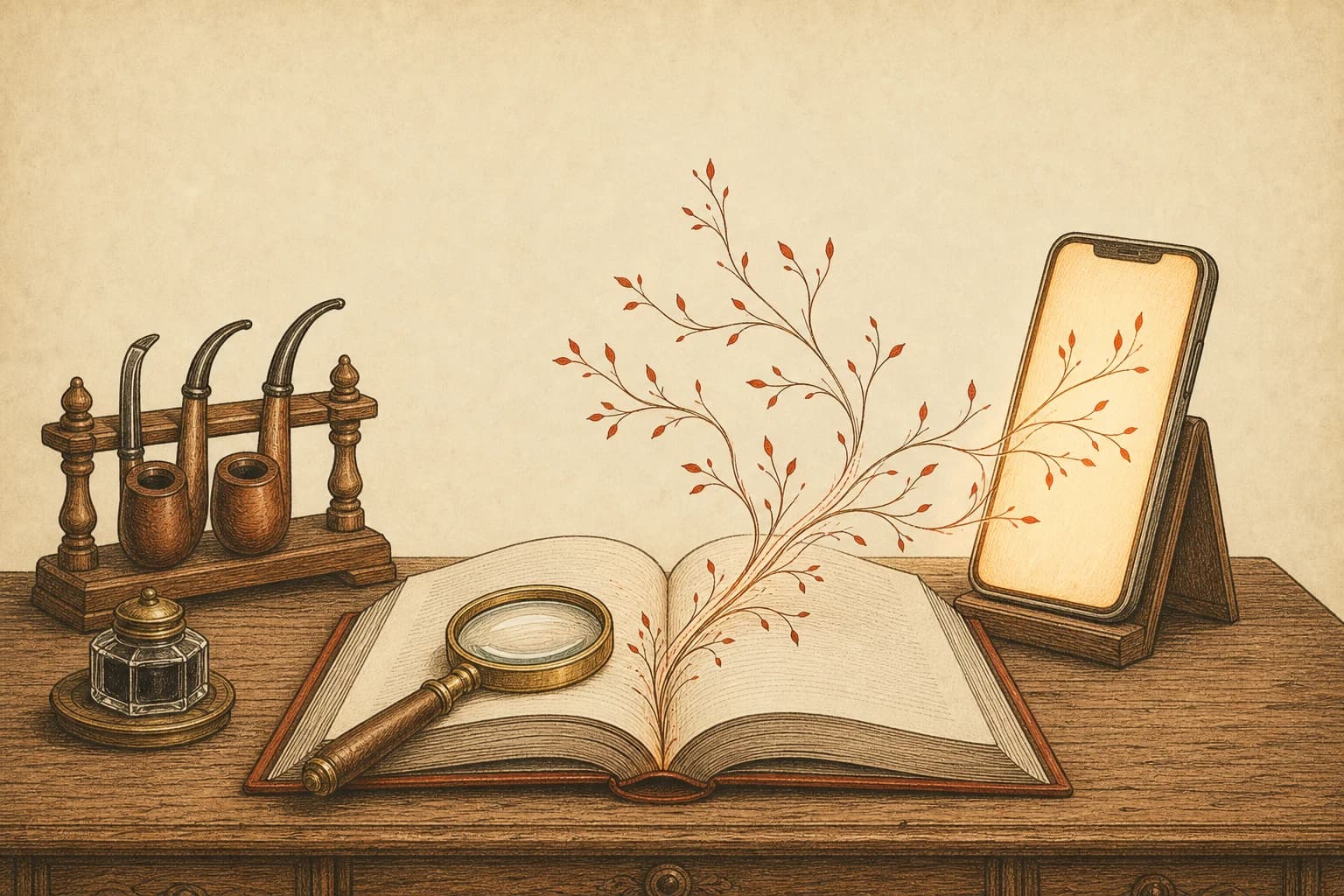
Arthur Conan Doyle wrote 56 short stories and four novels about Sherlock Holmes — devotees call them the sacred sixty. Everything else is other hands: parodies printed while Doyle was still alive, The Exploits of Sherlock Holmes written by his own son with John Dickson Carr in 1954, and in 2011 The House of Silk, the first novel officially endorsed by the Conan Doyle estate. Add more than 250 stage and screen portrayals and the pastiche shelf outweighs the canon many times over. Continuing Holmes is not a transgression against the original. It is the original’s afterlife, and it has been running for about 130 years.
What changed recently is who gets to join without lawyers. For decades the estate collected licensing fees from pastiche authors and publishers, and for a while it argued in court that the characters themselves stayed under copyright as long as any single story did. That theory lost. Since January 1, 2023, the entire canon is public domain in the United States, and the game is open to anyone with the text and an evening.
The legal timeline, in three sentences
By 2013, 50 of the 60 stories had aged into the US public domain, and Klinger v. Conan Doyle Estate — decided in December 2013 and affirmed by the Seventh Circuit in 2014 — established that the Holmes and Watson characters were “free for public use”; only original elements introduced in the still-copyrighted late stories remained protected, which produced the genuinely absurd interim rule that Holmes was free but his late-period fondness for dogs was not. The last ten stories, collected in The Case-Book of Sherlock Holmes (1927), expired year by year until Public Domain Day 2023 closed the file. In the UK and other life-plus-70 jurisdictions this was old news — Conan Doyle died in 1930, so copyright there ran out at the end of 2000.
A working setup, start to finish
Source text first. Project Gutenberg posted The Case-Book on January 3, 2023 — two days after its copyright died — which completed the free, legal, full canon; every earlier collection has been there for years. Download epub or plain text, import it into a reader that does AI continuation, and the whole canon sits on your phone. In Foreverse the import is drag-and-drop for txt and epub, and everything you generate lands in branches while the original text stays byte-for-byte untouched.
Then pick your entry point, and here Holmes hands you a gift no other classic quite matches: Watson. Almost the entire canon is narrated by one man with one voice — decent, slightly baffled, precise about medical detail, discreet about names. A first-person narrator is the strongest style anchor a continuation can have, because the model is not imitating an abstract “Victorian style”; it is imitating a specific character with hundreds of documented pages of voice. Select the final paragraph of any story, ask for the continuation in Watson’s narration, and the constraint does half the stylistic work before the model writes a word.
Watson also constrains information, which keeps generations honest. He only knows what he witnesses. A model narrating as Watson cannot casually dump the solution, because the narrator himself has not deduced it — the structure of the mystery survives the handover from author to machine better than in third-person omniscient fiction.
Where to break in is a matter of taste, but three entry points have a century of precedent behind them. Continue past the end of a story you love, the classic pastiche move. Start from the retirement era — the canon leaves Holmes keeping bees on the Sussex Downs, decades of unwritten cases implied. Or pick one of the untold cases Watson mentions and never delivers; more on those below. Whichever you choose, select the paragraph where your version departs and continue the story from there. The original stays intact.
What the models will hold, and where they break
Full honesty about our evidence: our published continuation arenas ran on Chinese novels, not Victorian English, so we will not fake a model ranking for Conan Doyle. What does transfer is the mechanics. Across 360 rounds of long-run testing, every failure fit one of three patterns — restart loops (the model rewrites the original ending every round), mid-run freezes (it locks onto its own recent output and repeats verbatim), and ending rewinds (texture stays perfect while the plot folds back to the anchor point). These are context-feedback failures, not language failures. They will happen in English exactly as they happened in Chinese, and they only surface after many consecutive rounds — which is precisely how a pastiche gets written.
The second transferable result: no ranking survives a genre change. Our fast-plain-prose champion dropped to sixth place on an ornate palace-intrigue novel, while its stablemate — criticized in fantasy for over-describing — took first there, because a finer pen was exactly that book’s register. Conan Doyle’s formal 19th-century narration sits far from the register most models are tuned to produce by default, so the practical advice is boring and reliable: run the same scene through two or three models, read them side by side, keep the one that sounds like Watson rather than like a costume. One more expectation to set: in every arena we have run, all models converge toward uniform sentence length — the deepest machine fingerprint we know — so your editing pass should deliberately break long sentences and let short ones stand alone.
Two mitigations from that testing shipped into the product, so you inherit them instead of rediscovering them. The context sent to the model labels which passages are Conan Doyle’s and which are earlier AI continuations, with wording that survived our ablation tests — the naive phrasing caused one major model to restart from the original ending on 20 consecutive rounds. And because every generation lands in a branch rather than overwriting anything, a failure loop costs you one discarded branch, not a corrupted manuscript.
Branch play: the Reichenbach problem
Here is the part of this hobby that suits branching better than any other canon. Conan Doyle himself performed the most famous retcon in fiction: he killed Holmes at the Reichenbach Falls in 1893, and brought him back in 1903 after a decade of public pressure. The canon already contains its own fork. With branches you can hold both lines at once — one where “The Final Problem” is final and Watson writes the rest of his life alone, one where the Great Hiatus plays out differently, a third where Moriarty walks away from the falls instead. Each branch keeps its own text and its own context; none of them overwrites the canon or each other.
And if you want prompts the canon itself endorses: Watson name-drops dozens of cases he never wrote up, including “the giant rat of Sumatra, a story for which the world is not yet prepared”. Pastiche authors have been paying off that IOU for a century. Select the line, open a branch, and take your turn.
The cost of the experiment, for the record: signup grants 5,000 credits, roughly 260 continuation segments on the official channel — enough to draft a full untold case before deciding whether the hobby deserves your own API key. The estate spent decades charging for this door. It is open now; the only thing left to pay is attention to whether your Watson sounds like a doctor or like a chatbot in a bowler hat.
FAQ
Is Sherlock Holmes really public domain now?
Yes. In the US, 50 of the 60 canonical stories had already aged into the public domain by 2013, and the Klinger v. Conan Doyle Estate litigation (decided 2013, affirmed by the Seventh Circuit in 2014) confirmed the Holmes and Watson characters were free to use. The last ten stories, collected in The Case-Book of Sherlock Holmes (1927), expired one by one until January 1, 2023, when the final two entered the US public domain. In the UK and other life-plus-70 countries, copyright ended decades earlier — Conan Doyle died in 1930. What remains off-limits is implying endorsement by the estate, which is a trademark matter, not copyright.
Will the AI actually sound like Conan Doyle?
Honest answer: it can hold the register — formal Victorian narration, Watson's clinical warmth, period vocabulary — but surface mimicry is not the same as the real thing, and our own evals keep proving it. In 360 rounds of continuation testing we saw the best prose mimic in the field reproduce an author's comma rhythm almost perfectly, then rewind the entire plot in the final rounds. Expect a competent impersonation that needs your editing, not a resurrection.
Can I publish my Holmes pastiche?
The copyright side is clear: the original canon is public domain, so continuation and publication are lawful in ways that fanfiction of in-copyright works is not — an entire commercial pastiche industry already exists. Two practical caveats: don't imply official endorsement (trademark territory), and if AI wrote part of it, disclose that wherever you publish — most platforms now have explicit AI-content rules and quietly breaking them gets works removed. Not legal advice.
Which model should I use for Victorian-era prose?
We haven't run a Victorian-English arena yet, so we won't invent a ranking. What our Chinese-fiction arenas did establish transfers as a method: no ranking survives a genre change (our fast-plain-prose champion fell to sixth on an ornate court novel), so test two or three models on the same scene from your actual book and compare. In Foreverse you can switch models per scene with your own keys — 62 providers — so the test costs a few minutes, not a subscription.
Questions or ideas? Join our Discord →