
Slop creep is a mechanism — and it has a floor number
Same model, same instruction: a fresh chat obeyed 10 rounds out of 10, a chat with polluted history disobeyed in 9. Long-chat degradation isn't the model getting dumber — it's the model imitating its own old output, with the imitation weight growing every message. The mechanism, what our 300-turn benchmark measured (image-level repetition, +2% to +4.9% reply inflation per turn, rule decay from 253 to 631 words), how the Chat Archaeology lab draws the creep as a curve with a detected inflection floor, and a recovery playbook ordered by surgery size.
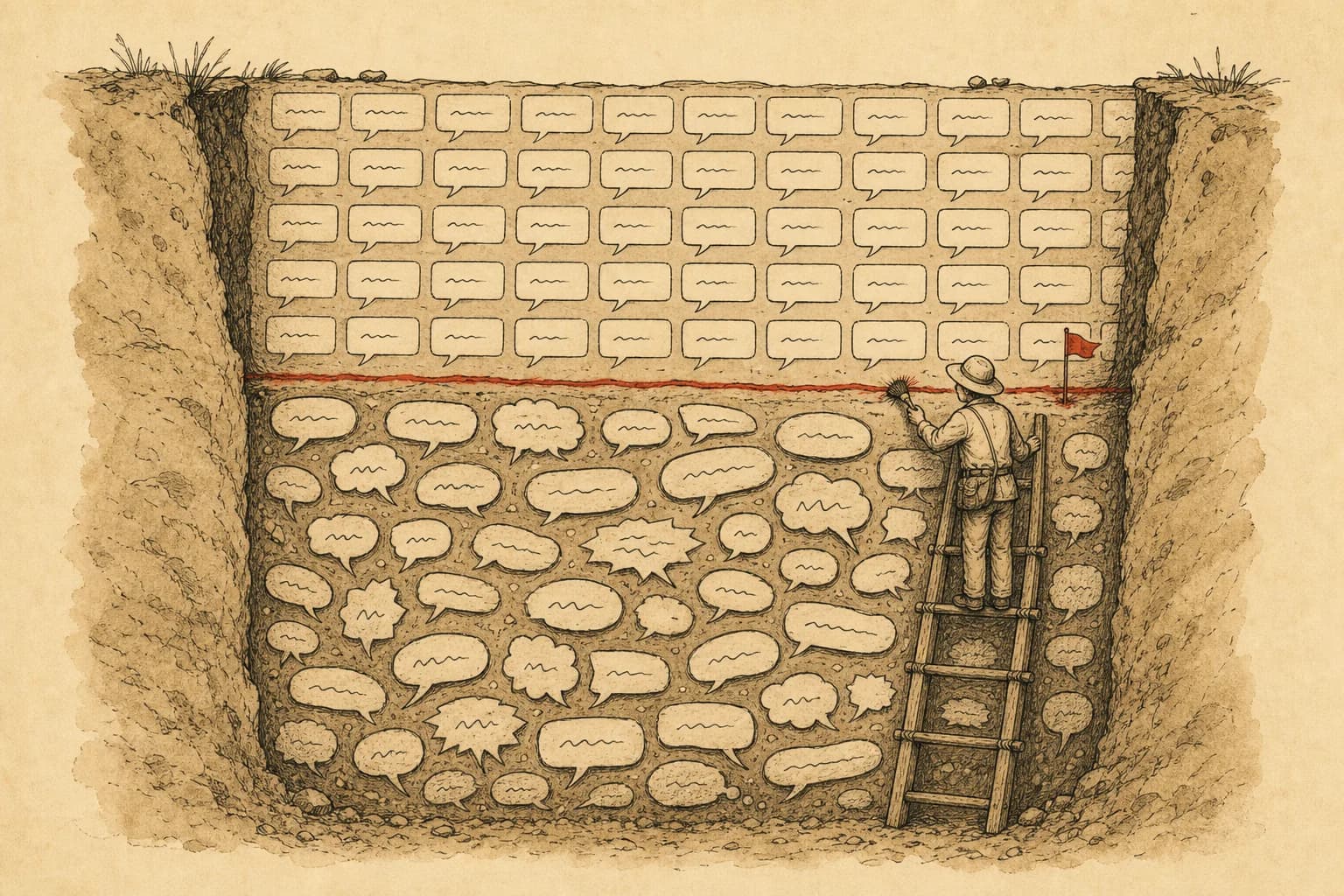
Anyone who has taken one character past a few hundred messages knows the arc. Early on the bot is sharp — it calls back your jokes, replies land short and specific. Somewhere past message 500, "a mix of amusement and something darker" shows up for the third time this week, every reply is a wall of text, and you catch yourself rerolling more than reading. The community has a word for where this ends: slop.
The two folk explanations — the model got dumber, the novelty wore off — both fail the same test. Same model, same card, fresh chat: instantly alive again. Only one thing changed across those 800 messages, and it's the history.
The mechanism: the model is imitating itself
While building our companion texting mode we ran a controlled pair that we still quote internally. Same model (DeepSeek V4 Flash), same instruction: talk like you're texting, no stage directions. In a fresh chat, 10 rounds, zero violations. Then we planted the same instruction in a chat whose history was full of asterisk-style stage directions — and it broke the rule in 9 rounds out of 10. Bolding the instruction and repeating it clawed back only part of the damage.
The instruction says it once. The history demonstrates it eight hundred times. That vote isn't close.
The loop underneath is unglamorous. Each turn, your instruction is a few hundred tokens of the prompt; history is tens of thousands — and to a language model, history is one giant few-shot example of how this conversation is written. In a long chat, that example is almost entirely its own past output. The first time "breath hitches" slips through, it enters history. Next turn the model reads itself having written it, and the phrase gets a little more probable. By the fourth appearance it's the house style. Every message fertilizes the next one.
What 300 turns actually does
This July we benchmarked our app four ways against SillyTavern (the full comparison data is public), including a 300-turn long-chat tier. Three findings belong in this story, because they feed each other.
Repetition goes up an abstraction level. On 15-turn chats, verbatim-repetition detectors read zero across all four systems — current models don't copy sentences. Count recurring imagery on the 300-turn corpus instead and it surfaces immediately: on the worst-affected system, the same little gesture — a character folding an osmanthus branch — came back in 21 of 27 sampled turns. Not repeated sentences. Repeated muscle memory.
Replies inflate. Across the four systems, reply length grew between +2.0% and +4.9% per turn. A "keep replies under 200 words" rule set at turn 3 decayed monotonically on the worst system: 253, then 290, then 365, then 631 words. The interesting part: re-stating the rule once at turn 14, in a stricter form, snapped all four systems back into compliance that turn. The rule never died — it was diluted by tens of thousands of tokens of counter-example.
And the good early material physically leaves. Once the context window fills, the oldest messages fall out first. Your character card gets re-sent every turn — what falls out is the actual conversation: the first fifty messages where the voice was still sharp. From that point on, the examples the model can imitate skew worse every turn.
Inflation fills the window faster; the full window evicts the good examples; the bad examples breed more slop. Three gears, one direction.
Drawing the curve
The Chat Archaeology lab does something blunt with this: drag in a SillyTavern chat export (.jsonl) and it scores every AI reply with the same rule engine as our prose-lint tool — 55 stock phrases at 0.6 points each, 8 sentence molds at 1.2 points past quota, from a clean 5 down to 0 — then plots the score message by message. Slop creep, as a line.
The inflection marker is the part we're fond of. It doesn't hunt for the lowest point; it hunts for the earliest sustained decline: baseline from your first 15% of messages, then a sliding window that has to drop 0.7 below that baseline and never recover. Single scores wobble. "Below baseline and it stayed there" doesn't.
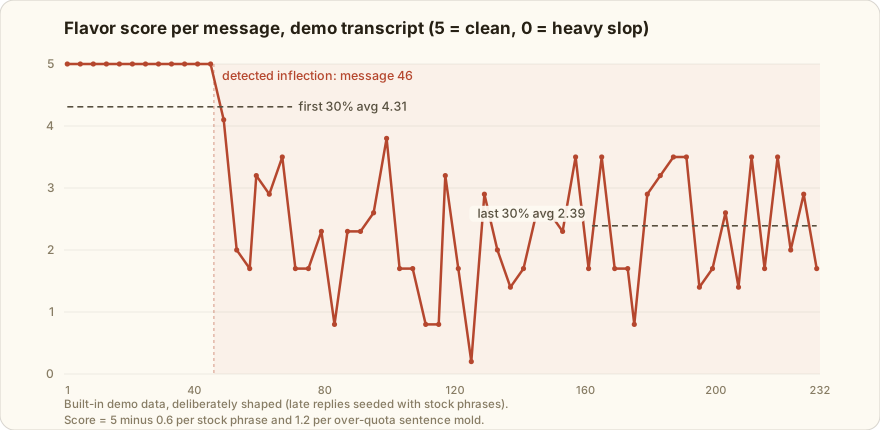
That's a real run over the built-in demo transcript — 232 messages across 91 days with a late-night convenience-store character. Clean 5s for 45 messages, inflection flagged at message 46, first-30% average 4.31 against last-30% average 2.39. The same report shows the replies growing from 35 to 84 words on average, and one message at floor 146 that got rerolled 7 times. The hesitation is part of the record too. You also get the night-owl ratio, who broke the longest silence, and what the whole relationship would cost to replay at today's API prices.
The recovery playbook
Ordered by how much surgery each step is; the first three cover most cases:
- Locate before you operate. Get the inflection floor from the report — fixing a leak starts at the leak, not by re-reading 800 messages on vibes.
- Edit or delete the source messages. Go to the floor where the creep starts and rewrite the first few contaminated replies. This beats writing "no clichés" in the prompt by an order of magnitude — you're fixing the demonstration, and the demonstration outvotes the instruction (the zero-violations vs nine-violations pair above is the receipt).
- For bigger damage, rewind. Cutting the chat back to a chosen message removes the contamination wholesale — our app has a "restart from this message" action; deleting down to a floor in SillyTavern does the same. Cost: the story after that point goes with it.
- Turn on summarization for long chats. Replacing distant history with a summary physically evicts the bad examples and makes your instructions heavy again. We ship auto-summary and context compaction in the plugin center; SillyTavern has Summarize. Honest cost: summaries drop detail.
- Re-state your rules. In the benchmark, repeating the length rule once at turn 14 brought all four systems back that turn. A rule set at message 3 will not police message 300 on its own — top it up.
- The full reset: start a new chat with memory. A fact-memory engine carries what the character knows into a fresh session — history goes to zero, the relationship doesn't. That "instantly alive again" feeling is just clean context.
Rerolling isn't on the list because it can't treat a trend: it re-rolls the dice without changing the pot. The player at floor 146 pulled seven ladles from the same soup.
The lab is at /labs/chat-archaeology. Fully in-browser, nothing uploads; a 12MB, thirty-thousand-message export parses in about 1.3 seconds (single files up to 48MB); the share card at the end is built from counters only and structurally cannot contain a line of your chat.
Last thing, on what the curve is worth. It only knows its word list. It says message 46 is where the flavor turned — go read those floors yourself and your nose will probably beat it there. Its job is converting "this got stale at some point, I think" into "floor 46, go fix it."
FAQ
Is the model getting dumber as the chat gets longer?
No. Same model, same card, fresh chat — the spark is instantly back. The weights never changed; the context did. In a long chat, history makes up almost all of the prompt, and that history is the model's own past output. Every turn it imitates itself a little harder, so one stock phrase left in place compounds. It's a context-distribution problem, not a capability problem, which is why waiting for the next model version doesn't fix it.
Will switching to a stronger model fix slop creep?
It changes the vocabulary of the slop, not the loop. We ran a 400-turn companion memory benchmark across model families (full write-up on this blog) and a four-way system comparison where the identical model scored 78% to 94% on instruction-following depending purely on how each system managed context. Self-imitation works the same on every model — what bends the curve is history management, not parameter count.
Is the flavor score an objective measurement?
No, and the tool says so on the page. It's a rule-based score: 55 stock phrases and 8 sentence molds, deducted from a clean 5 down to 0. Machine-flavored prose that isn't in the word list passes unseen; a human who genuinely loves one listed phrase loses points. Treat it as prose lint, not a verdict — its real strength is applying the same ruler from message 1 to message 3,000, so the trend and the inflection point are far more trustworthy than any single score. Also honest: the scorer is calibrated for Chinese only right now; English exports get a plain 'not calibrated' note on that one panel while every other panel still works.
Why do ten rerolls all smell the same?
Because a reroll changes the dice, not the pot. The context fed to the model is byte-identical across rerolls — and the contamination lives in the context, not in the sampling seed. In our demo transcript one message got rerolled 7 times and all 7 candidates carried the same stock phrases. Reroll when one reply misses; when the trend is off, you have to operate on history: edit, rewind, or summarize.
Questions or ideas? Join our Discord →