
Four characters at one table, and the director is an algorithm
Single-character AI chat is a solved genre. Group roleplay's hard problem lives elsewhere: turn-taking. Mentions must be answered, talkative characters should talk, silence needs a fallback, and nobody gets to spam the table. How we brought desktop-tavern group chat to a phone: the three-tier natural arbitration, four speaking strategies, three card-injection modes, and an auto mode that lets the scene run itself.
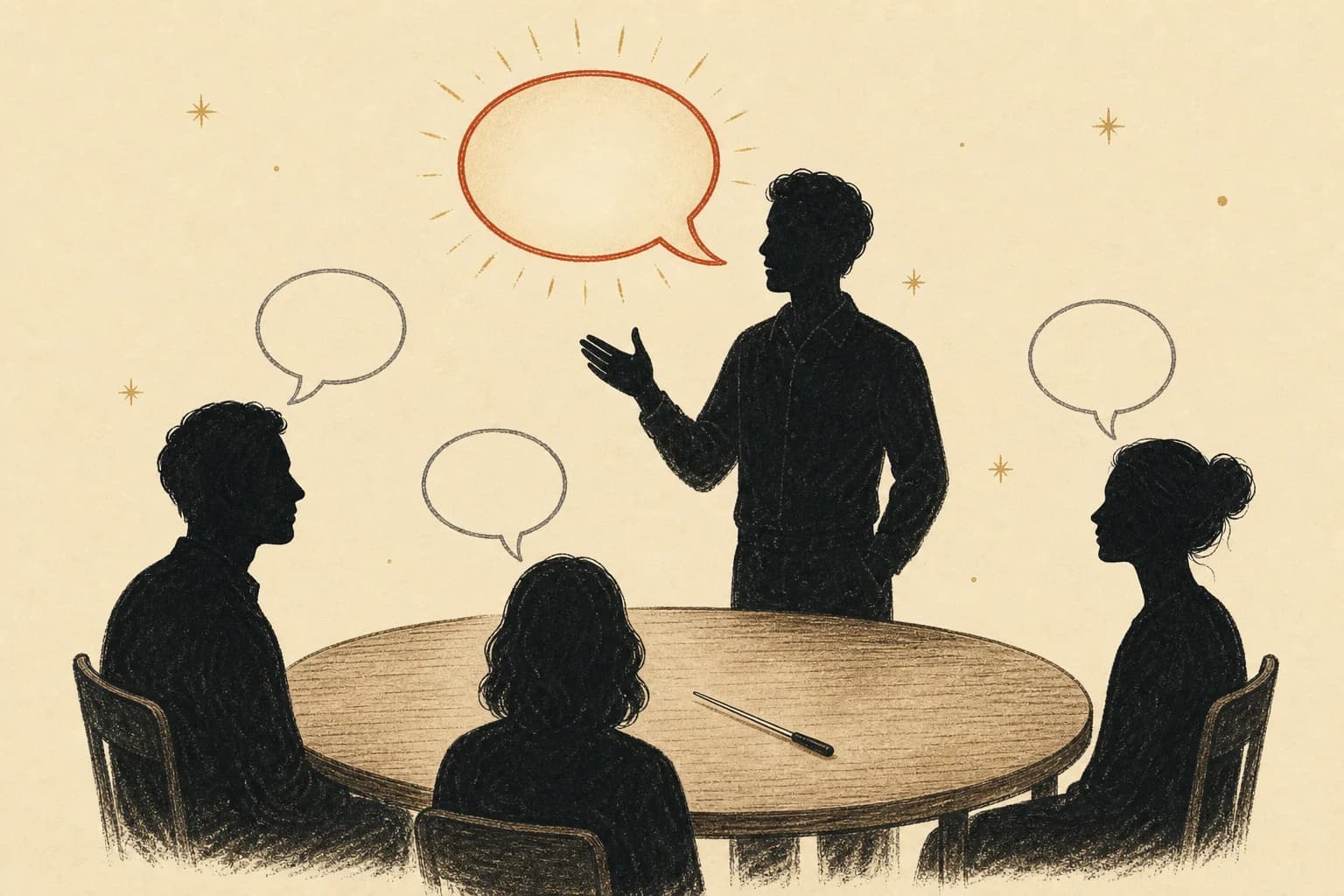
Single-character chat has matured into a settled craft. Group chat is different. Put four character cards into one session and the real engineering problem is not generation quality; it is a directing problem: who speaks next. Mentions must be answered. Talkative characters should grab lines. Silence needs someone to fill it. And no single mouth gets to spam the table. Desktop SillyTavern answered this with a set of arbitration rules refined over years; we carried them to the phone intact. Here is how the machine under the table works.
Natural rotation: three tiers of arbitration
| Priority | Rule | The intuition |
|---|---|---|
| 1 | Mentions win: name a character and they answer | You asked Lin directly, so Lin replies |
| 2 | Talkativeness-weighted draw over the members | Extroverts talk more, laconic types rarely — personality lives on the card |
| 3 | List-order fallback | When nothing else applies, someone still picks up the line; the scene never stalls |
Two constraints sit on top. The previous speaker is excluded by default, so a character cannot monologue the table into submission (a group setting re-allows consecutive turns if your scene wants them). And each turn carries a maximum-speakers budget — one message can draw out a couple of replies, not an avalanche from the whole cast.
Mentions also relay. If A's reply names B, B follows. A single “what do you two think?” can pull two characters into the scene one after another, which is where group chat starts feeling like theater instead of a queue.
Four strategies, four kinds of scene
Natural rotation suits everyday ensemble play, but it is one of four: natural (the arbitration above), list order (strict rotation, good for turn-based tabletop), manual (you appoint every speaker — full director mode), and random draw with a not-yet-spoken weighting so every character gets stage time. Anyone who writes ensemble scenes develops instincts for these: natural for slice-of-life, manual for interrogations, list order for game nights, random for tea parties. Switching takes effect immediately.
Card injection: tokens versus drama
Whose persona rides in each turn's prompt is a real-money question — cards run hundreds to thousands of tokens, and carrying four at all times quadruples the standing cost. Three modes: solo injects only the current speaker's card (cheapest; characters stay mutually opaque), merged-enabled injects every active member's card (richest interplay, priciest), merged-all includes even muted members for present-but-silent staging. None is universally right. For long arcs we run solo to protect the budget and switch to merged-enabled for pivotal confrontations.
Auto mode: let the scene run
The best version of group chat is the one where you move to the audience. Auto mode schedules the next speaker after each reply lands, on an interval you set. Our acceptance run had six full rotations on a real model: speakers alternated, the consecutive-turn constraint held, and a user interjection cancelled the queue and re-arbitrated on the spot. Turning it off stops after the sentence in flight.
What is not finished
Two honest edges. The random strategy's not-yet-spoken weighting is covered by unit tests but still awaits its dedicated on-device verification round. And per-character private memory in groups (A remembers what B never learned) depends on the memory plugin splitting stores by speaker — that waits until the memory plugin hardens. How memory injection itself avoids burning your cache is measured in the memory experiment.
FAQ
How does an AI group chat decide which character speaks next?
The natural strategy arbitrates in three tiers: mentions first (name a character and they answer); otherwise a weighted draw over each character's talkativeness field (a standard card property); otherwise fall back to member-list order so silence never stalls the scene. The previous speaker is excluded by default to prevent spam, and each turn has a maximum-speakers budget.
Can I import group chats exported from desktop SillyTavern?
Yes. Desktop group JSON imports whole: member roster, speaking-order strategy, and group settings come together. Member cards must already be in your library; the import report lists anyone missing.
Do characters in a group see each other's personas?
That depends on the card-injection mode, and there are three: solo (only the current speaker's card is injected — cheapest, characters stay mutually opaque), merged-enabled (every active member's card goes in — full mutual knowledge, highest token cost), and merged-all (even muted members' definitions are included, for present-but-silent characters).
Can the group keep playing without me?
Turn on auto mode with an interval in seconds: after each reply lands, the next speaker is scheduled automatically and the scene rolls forward. Interject any time — your message cancels the queue and re-arbitrates; switch it off and it stops.
Questions or ideas? Join our Discord →