
Prompting AI to continue a story: what holds up after twenty rounds
Bare 'continue this' prompts decay measurably over consecutive rounds — we have the 20-round benchmark data. These field notes split the working prompt into an instruction layer and a material layer, explain the continuity directive that took one model from 20/20 restart loops to 0/20, and include four copy-ready English templates (fast action, interior-emotional, suspense, literary restraint), each with banned-phrase lists and a note on when to use it.
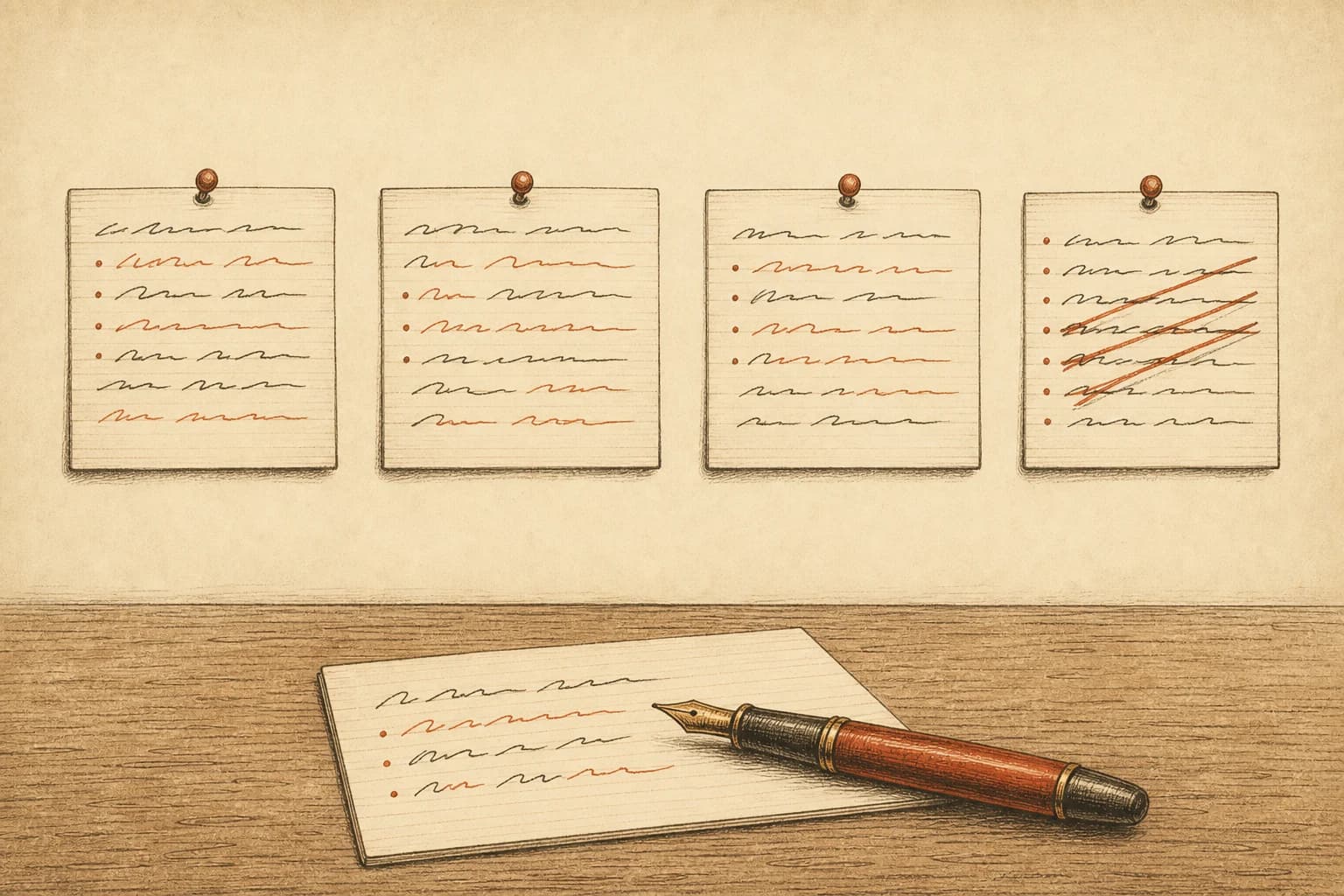
“Continue this” is the most common fiction prompt in existence and the weakest. The model is missing three decisions — how long, at what pace, and whose style is the reference — so it fills them with the statistical average of its training data: medium-length sentences, even paragraphs, a register best described as generically competent. One round of that is tolerable. The problem is what happens over many rounds, because continuation is never one round.
Why bare prompts decay: the 20-round evidence
Continuation has a feedback loop built in: each round’s output goes back into the context for the next round. Run that twenty times, as we did across six models on the same 8.9M-character novel, and the context gradually becomes the model’s own prose instead of the author’s — so the model increasingly imitates itself. The numbers are blunt: the original’s sentence-length variation coefficient was 0.84; all six models drifted into a 0.46–0.59 band. Left unmanaged, the loop also produces harder failures — restart loops, verbatim freezes, plot rewinds — and the freeze variant has been documented since the GPT-2 era: Holtzman et al.’s degeneration study showed repetition is self-reinforcing, with each repeat raising the probability of the next.
The practical conclusion from those runs is that a working continuation prompt is not one clever sentence. It is a small system with two layers, and most of the failures we see come from stuffing layer-two problems into layer one.
The two layers, and what goes in each
The instruction layer says how to write: output length, pacing rules, point-of-view and tense locks, and a banned-phrase list. The material layer says what is true: the recent story text, any setting or character sheets, and — critically — labels for which passages are original prose and which are earlier AI continuations. Instructions govern diction. They do not govern world state or canon; twenty rounds into our benchmark, models given style rules but weak material anchoring had collectively wandered from a blood-cloud ritual array into sunlit forests. No adjective in the prompt fixes that. Structure the layers separately — the same separation OpenAI’s prompt engineering guide recommends as instructions versus context, with clear delimiters between them.
One material-layer directive deserves its own paragraph, because it produced the largest single swing we have ever measured. Labeling earlier AI output “for plot continuity reference” caused one model to treat those passages as non-canon and restart from the original text’s ending — 20 rounds out of 20. Rewriting the label as two explicit statements (these passages are canonical events that already happened; continue from the very last paragraph; anchor style to the original prose only) brought regressions to zero. If you build your own context by hand, include that canon declaration. It is one sentence of insurance against the most common long-run failure there is. And weigh what you paste: our benchmark chains ran on a fixed 16k-token window, and a hand-built context that silently overruns the model’s budget gets trimmed from the top — the free character card token counter takes any text or card and shows the weight under six tokenizer families before you spend a single request.
Four copy-ready templates
These four are written in English for this post, following the same principles as the official packs we ship — three-part structure: output rules, craft rules for the genre, banned list. Paste one after your story material, adjust the numbers to taste, and extend the banned list with whatever tics your model keeps producing. That last habit matters more than any starting template: a banned list is a living document.
1. Fast-paced action
When to use: progression fantasy, thrillers, anything where the failure mode is the AI padding three paragraphs of scenery while the protagonist “gathers his thoughts”.
2. Interior / emotional
When to use: romance arcs and slow-burn relationship lines, where one unguided continuation will happily jump from first eye contact to a confession.
3. Suspense
When to use: mysteries, horror, anything where the AI’s instinct to be helpful makes it dump the truth two paragraphs in — or, worse, announce that danger approaches.
4. Literary restraint
When to use: quiet literary fiction, where default model prose is too eager — too many metaphors, emotions named outright, every scene tied off with a bow.
What templates cannot fix
Three things, stated plainly so you spend your debugging time in the right layer. Model choice dominates: the gap between models imitating the same book is larger than the gap between prompts on one model, and the ranking flips by genre — audition before committing. Long-run drift is a material problem: it needs source labeling and the canon declaration above, not more forceful adjectives. And world-state consistency belongs to setting sheets and lore entries injected as material, not to a “remember all the details” line that a model will nod at and ignore.
Disclosure, since this post would be incomplete without it: Foreverse ships 23 official template packs in-app — 11 continuation styles, 3 branch-direction generators, plus video and illustration sets — free to import from the community tab. They are Chinese-first, written for the webnovel genres our earliest users read, and the full teardown of their contents is currently published in Chinese. Every official template is also laid out with full text and usage notes on the prompt template library — including two English-native packs (22 templates of dialogue craft and fiction styles; see Show, Don’t Tell and De-Slop for the flavor). The four English templates above are not translations of those packs; they apply the same three-part structure to the genres English readers ask about. Import a pack or paste a template — in the reader either becomes a saved option on the continuation form, and an imported template is yours to edit.
The honest endpoint of all this tuning is one number. Mean sentence length and dialogue ratio can be prompted and model-picked into range; sentence burstiness cannot — the author sat at 0.84, the six-model benchmark ranged 0.46 to 0.59, and even our best labeled follow-up run only climbed back to 0.64. If a continuation of your favorite book still reads slightly too even, too composed, that remaining gap is what you are noticing, and for now the fix is editorial, not prompt-shaped.
FAQ
Can a prompt fully clone the original author's style?
No — close, not perfect, and the gap is measurable. In our 20-round benchmark, no model matched the original's sentence-length burstiness: the source book's coefficient of variation was 0.84 and all six models landed between 0.46 and 0.59. Better context labeling reversed the decay direction in follow-up runs — one arm climbed from 0.56 back to 0.64 across rounds instead of sliding — but nothing we tried closed the gap fully. A good template plus source labeling plus the right model gets you to 'stays immersive on a straight read-through'; anyone claiming pixel-perfect style cloning from a prompt is overselling what prompts do.
How long should the excerpt I paste be?
Enough to carry the voice, not the whole book. Style lives in the material layer, so a few thousand words of the most recent text — the run-up to your continuation point — outperforms a plot summary of everything. Our benchmark chains ran on a fixed 16k-token window (roughly 12,000 English words) and that was sufficient context for the best pairings to read like the original. In a reader app that assembles context automatically you can skip this question; pasting by hand into a chatbot, favor the last several chapters over scattered highlights.
Why do these templates ban phrases instead of describing the style?
Because negative constraints are checkable and adjectives are not. A model cannot reliably act on 'write with more tension', but 'do not have the narrator announce danger before the character sees it' is a rule it can follow sentence by sentence — and that you can verify on read-through. The same logic applies to cliché lists: naming the exact constructions you keep seeing ('breath caught', 'time seemed to slow') removes them far more reliably than asking for 'fresh prose'.
Do these templates work in any AI tool?
Yes — they are plain instructions with no app-specific syntax, so they paste into any chatbot or writing tool. Two adjustments travel with them: supply the material layer yourself (recent story text, plus a line stating that earlier AI continuations are canon), since a raw chat window assembles no context for you; and re-send or re-reference the template on each round, because instruction adherence fades as the conversation grows.
Questions or ideas? Join our Discord →