
Continuing someone else's novel with AI: what US copyright law actually says
A private AI continuation you never share and a continuation you post or sell sit in different risk classes under US copyright law. This explainer walks the 17 U.S.C. §107 fair use factors, what Salinger v. Colting and Anderson v. Stallone actually decided, why the AI training lawsuits are a different fight from your personal use, and a plain do/don't checklist. Background information, not legal advice.
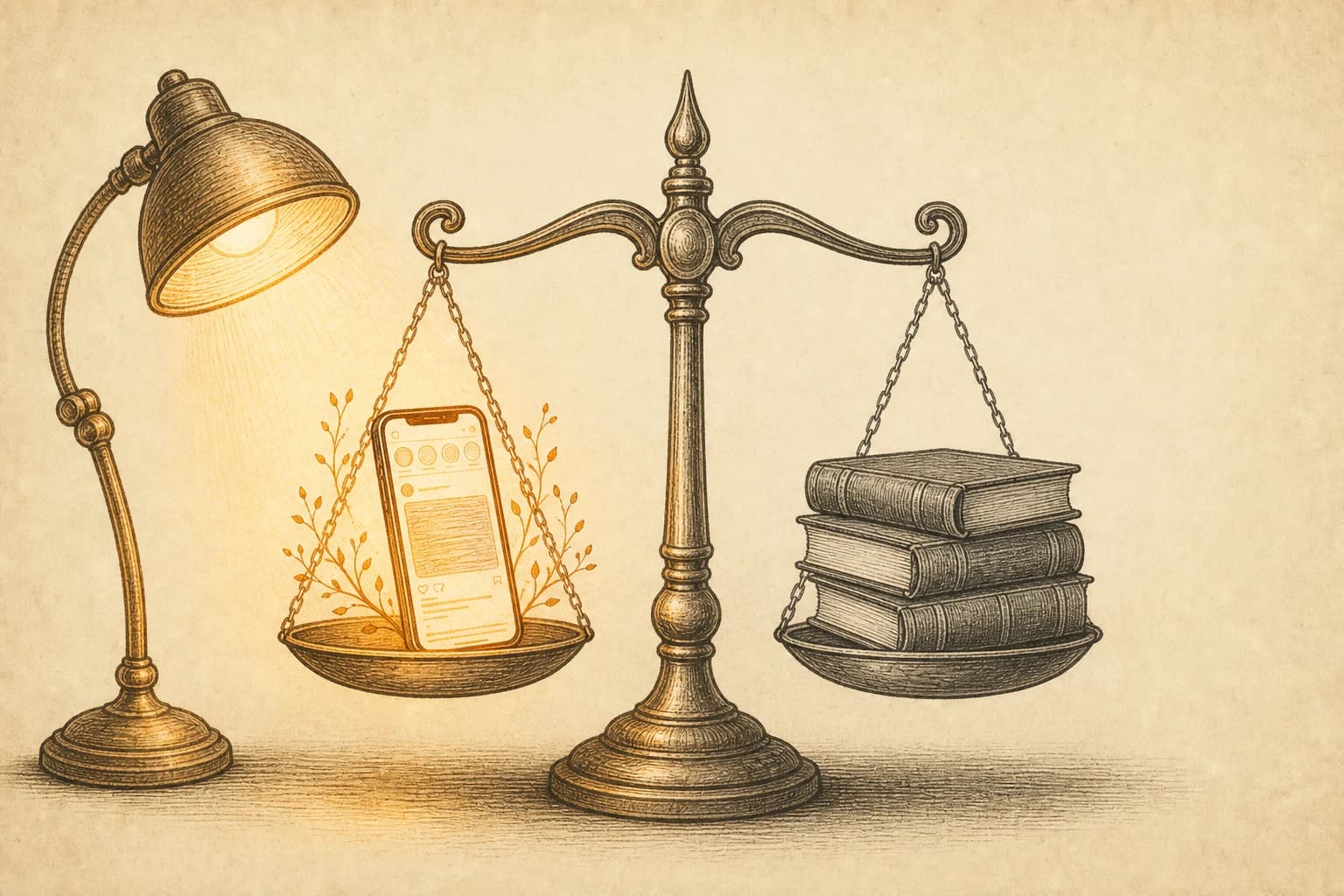
Short answer: US copyright law treats a continuation you generate for yourself and never share very differently from one you publish or sell. Every unauthorized-sequel dispute we could find in the case law involves publication, distribution, or an attempt to exploit the work commercially. Whether a purely private continuation is fair use has never been tested in court — and the four-factor framework goes a long way toward explaining why it likely never will be.
The question usually arrives in a less lawyerly shape: a book you love is finished, or abandoned, and you want to feed it to a model and read what happens next — for yourself, on your own phone. Search results split between “all fanfiction is infringement” and “nobody cares, do whatever”, and both answers are wrong in ways that matter. Here is the statute, the cases, and the honest gray areas, so you can see where the lines actually sit.
What does fair use actually weigh?
Fair use is codified at 17 U.S.C. §107, and it directs courts to weigh four factors: the purpose and character of the use (including whether it is commercial), the nature of the copyrighted work, the amount and substantiality of what was taken, and the effect of the use on the potential market for the original. No factor decides alone. Fair use is also an affirmative defense — something a court weighs after you are already being sued, not a permission slip anyone can stamp in advance.
The modern center of gravity is the first and fourth factors. In Campbell v. Acuff-Rose Music, 510 U.S. 569 (1994), the Supreme Court held that a commercial parody can be fair use, and that the key first-factor question is whether the new work is transformative — whether it adds new expression, meaning, or message rather than merely substituting for the original. The more transformative the use, the less the other factors weigh against it. A continuation written for private enjoyment sits oddly in this framework: its purpose is noncommercial, but a sequel is also the least transformative kind of derivative — it extends the story rather than commenting on it. Which is why the fourth factor, market substitution, ends up doing the real work in the sequel cases.
What did the unauthorized-sequel cases really decide?
Two cases carry most of the weight in this area, and both were fights about exploitation, not private writing. Read what was actually at stake in each and the private-use question comes back into focus: courts have condemned publishing and selling unauthorized sequels; they have never been asked to condemn writing one for yourself.
Salinger v. Colting, 607 F.3d 68 (2d Cir. 2010) is the modern sequel case. Fredrik Colting wrote and published 60 Years Later: Coming Through the Rye, featuring a 76-year-old version of Holden Caulfield, and set a US release date. The district court enjoined US publication in 2009. On appeal, the Second Circuit vacated that injunction — but on equitable-standard grounds, not because the book was fine: the court agreed Colting’s fair use defense was likely to fail, finding his claim that the book was a critique of Salinger not credible. Every step of that litigation targets publication and distribution. Nothing in it reaches a manuscript in a drawer.
Anderson v. Stallone (C.D. Cal. 1989) is stranger and more instructive. Timothy Anderson wrote a 31-page treatment for a Rocky sequel and pitched it to MGM, hoping to be paid; when Rocky IV came out, he sued, claiming it used his material. The court ruled against him twice over: his treatment was an unauthorized derivative work built on protected characters, and under 17 U.S.C. §103(a) it received no copyright protection — the court found the treatment so pervaded by the Rocky characters that no part of it could be protected. Note who was suing whom. Nobody hauled Anderson into court for writing the treatment — the holding surfaced when he tried to assert rights in it. The case is less “you may not write sequels” than “an unauthorized sequel is legally inert: you cannot enforce it, license it, or build on it.”
Doesn’t copying a whole book always lose?
No — and the counterexample is the most consequential fair use case of the last decade. In Authors Guild v. Google, 804 F.3d 202 (2d Cir. 2015), Google scanned millions of complete books without permission to build a search index, and the Second Circuit called it fair use: the copying served a transformative purpose and the snippet results were no substitute for buying the books. The lesson for our question is narrow but real. Wholesale copying is not automatically fatal; what courts keep circling back to is whether the use supplants the market for the original. A private continuation that nobody else can read substitutes for nothing — which is precisely the posture that has kept this scenario out of the case reporters.
Where does AI actually change the question?
Less than the headlines suggest, once you separate two very different acts: an AI company copying millions of books to train a model, and you sending a few chapters to a model to get one continuation back. The lawsuits you have read about are almost entirely the first kind. In Bartz v. Anthropic, a federal judge ruled in June 2025 that training on lawfully acquired books was fair use — while holding that Anthropic’s storage of more than seven million pirated books was infringement, a split that led to a court-approved settlement of $1.5 billion — about $3,000 per pirated work — in the fall of 2025. Whatever else that litigation wave settles, it is a fight between model vendors and rightsholders over training corpora. Its outcome does not decide whether your private continuation is lawful, any more than a lawsuit against a photocopier maker decides what you may photocopy.
Two genuine gray areas remain on the personal side, and honesty requires naming them. First, US law has no general private-use exception: making a copy or a derivative work is within the copyright owner’s exclusive rights even in your own home, so a private continuation rests on fair use rather than on an explicit statutory carve-out. Second, sending chapters to a cloud model creates transient copies on someone else’s servers, an act the statute never contemplated and no court has analyzed in this context. Both points cut against pretending the private path is formally cleared. Neither changes the practical picture: no market harm, no discovery trail, no plaintiff on record ever bringing that case.
Who owns what you generate?
Probably less than you hope, on two independent grounds. The US Copyright Office’s Copyright and Artificial Intelligence report, Part 2 (January 2025) concluded that purely AI-generated material cannot be copyrighted and that prompts alone do not supply the human authorship copyright requires; protection reaches only identifiable human contributions — creative selection, arrangement, or modification — judged case by case. And even for the parts you genuinely authored, the derivative-work overlay from Anderson applies: where your continuation uses the original’s protected material unlawfully, §103(a) strips protection from those portions. For private use this is academic. It becomes very real the moment you consider publishing: you would be defending a work you mostly cannot claim.
A checklist you can act on
The lower-risk profile, and the one this whole analysis assumes:
- Your source copy is lawful — a purchased ebook or an authorized free release;
- The continuation stays on your own device, read by you;
- No posting, no paywalls, no tips, no passing it off as the author’s work.
Each of these moves you into the territory where the case law actually lives:
- Posting it anywhere public — free posting is still distribution, and free was no defense in the sequel cases. Platform rules are a separate layer: AO3’s stated policy currently permits AI-assisted fanworks that otherwise qualify, but an archive’s permission is not a rightsholder’s. If you go this way anyway, our fanfiction piece covers disclosure norms;
- Charging money in any form — the fastest way to make the fourth factor unwinnable;
- Using a pirated source file — an independent infringement under everything else;
- Implying the author or publisher endorsed it.
Product note, briefly, because it explains why we researched this: the Foreverse reader is built for exactly the first list. Books import from files you already own, continuations grow on branches while the original text stays byte-for-byte untouched, everything lives on your device, and there is no publish button attached to your branches. That is a design stance, not a legal shield — but it keeps the default behavior on the side of the line where no plaintiff has ever stood.
Required, and meant: this article is background information about US law compiled from public sources, not legal advice, and copyright outcomes turn on specific facts. If your situation involves publishing, monetizing, another country’s law, or anything you are unsure about, consult a licensed attorney before acting.
FAQ
Can I get sued for a private AI continuation I never share?
Anyone can file a lawsuit over almost anything, so no honest answer is 'zero risk'. But we could not find a single reported US case in which a rightsholder sued a reader over a private, non-distributed continuation — the litigated sequel disputes (Salinger v. Colting, Anderson v. Stallone) all involve publication or an attempt to exploit the work. A purely private use also gives a plaintiff no way to discover the work exists and no market harm to point at under the fourth fair use factor. Untested is not the same as blessed, but the practical exposure is very different from posting.
What changes if I post my continuation to AO3?
The risk class changes entirely: posting is public distribution, and every sequel case that reached a courtroom lived on that side of the line. Platform policy is a separate question from copyright — AO3's Terms of Service currently do not prohibit AI-assisted fanworks that otherwise qualify as fanworks, but an archive's permission is not the rightsholder's permission. Noncommercial, genuinely transformative fanwork has a real fair use argument under Campbell v. Acuff-Rose, and it remains an argument, not a settled rule. If you post: disclose the AI involvement, never monetize, and accept that a takedown request can end the discussion.
Who owns the AI-generated part of the continuation?
Two layers stack against you. First, the US Copyright Office's January 2025 copyrightability report says purely AI-generated material is not copyrightable, and prompts alone are not enough human authorship — protection attaches only to identifiable human contributions such as creative selection, arrangement, or rewriting, judged case by case. Second, a continuation is a derivative work: under 17 U.S.C. §103(a), as applied in Anderson v. Stallone, the parts of an unauthorized derivative that use the original's protected material unlawfully get no copyright protection at all. In practice you may own very little, and what you do own does not come with the right to publish it.
Does it matter where my copy of the book came from?
Yes, and the AI training litigation just made the point loudly. In Bartz v. Anthropic, the court treated training on lawfully purchased books as fair use while treating the retention of millions of pirated copies as infringement — acquisition was analyzed as its own act. The same logic reaches individuals: feeding a bought ebook to a model for a private continuation starts from clean facts; a pirated file plants an independent infringement underneath everything you do afterward. Buy the book.
Questions or ideas? Join our Discord →